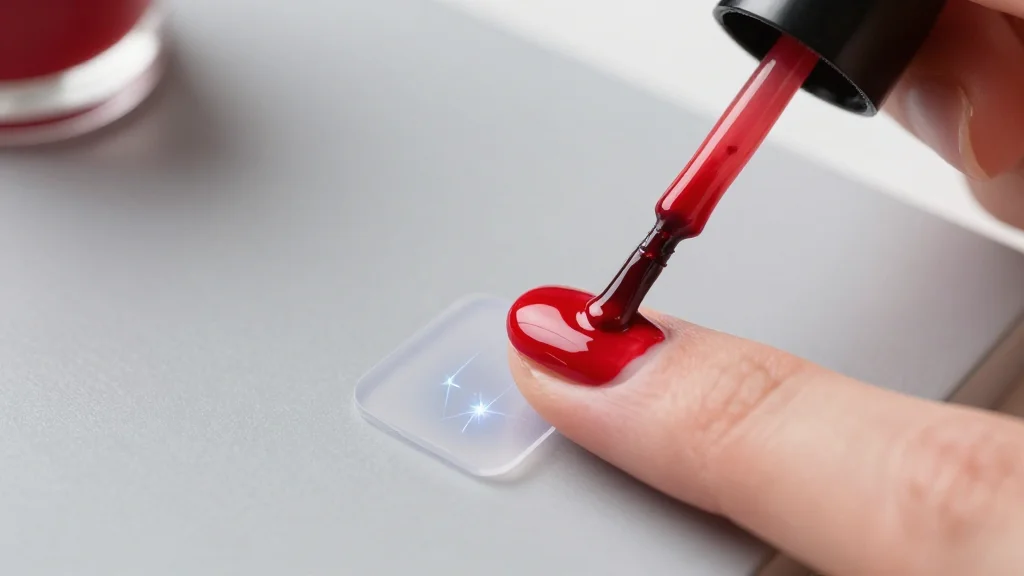
Ordinary Nail Polish Turns Surfaces Into Removable Nanogenerators
Key Takeaways
- •Nail polish serves as paintable triboelectric layer for TENGs.
- •Optimized PDMS pairing yields ~400 V, 40 µA, ~7 mW power.
- •Coating is removable, re‑configurable, and survives 20 k cycles.
- •Performance consistent across brands; dilution with acetone fine‑tunes output.
- •Enables low‑cost, on‑demand energy patches for sensors and indicators.
Pulse Analysis
Triboelectric nanogenerators have long promised a way to harvest ambient mechanical energy, but their adoption has been hampered by complex fabrication and the need for specialized polymers. By repurposing a mass‑produced nail‑paint formulation—already engineered to spread, dry, and adhere—researchers sidestep these hurdles. The nitrocellulose‑based film contains electron‑donating groups that become tribo‑positive, enabling charge transfer with common counter‑materials such as PDMS. This chemistry‑driven approach preserves the essential physics of TENGs while leveraging a consumer‑grade coating process that requires only a brush and a drying step.
Performance metrics show the nail‑paint TENG can reach 400 V and 40 µA, delivering about 7 mW—enough to charge capacitors and light LEDs or run a digital clock. Crucially, the device remains stable after 20 000 contact cycles and endures water immersion, oil exposure, sand, heat up to 100 °C, and repeated bending. Diluting the paint with acetone fine‑tunes film thickness and surface wetting, improving output without sacrificing durability. The ability to wipe or re‑paint regions means the active area can be reconfigured on demand, a flexibility rarely seen in printed energy harvesters.
For the IoT and wearable markets, this development could lower the cost and complexity of deploying self‑powered sensors on irregular or temporary surfaces—think floor tiles that generate power from foot traffic, removable health‑monitoring patches, or emergency indicators on disaster‑relief equipment. Limitations remain: the generated power is intermittent and best suited for low‑duty‑cycle devices, and large‑scale commercial rollout will need to address solvent safety and material compatibility across diverse substrates. Nonetheless, turning a ubiquitous cosmetic into a functional energy‑harvesting coating signals a pragmatic shift toward surface‑mounted power solutions that can be applied and removed as easily as paint.
Ordinary nail polish turns surfaces into removable nanogenerators
Comments
Want to join the conversation?