'Poor Man's Majoranas' Can Be Used as Quantum Spin Probes
Key Takeaways
- •Minimal Kitaev chain with two quantum dots acts as a spin spectrometer.
- •Spillover induced by magnetic coupling creates subgap levels revealing particle statistics.
- •Fermionic spins produce 2S+1 subgap states; bosonic spins produce 2S+2.
- •Environmentally induced protection can stabilize poor‑man's Majoranas in transport setups.
- •Existing InSb nanowire platforms can test the proposed quantum probe experimentally.
Pulse Analysis
The quest for Majorana fermions has driven much of modern condensed‑matter research because their non‑abelian statistics promise fault‑tolerant qubits. In practice, achieving the long, topologically protected Kitaev wires required for robust quantum bits remains a formidable materials challenge. Researchers therefore label the much simpler, two‑dot realization a “poor man’s Majorana” (PMM), acknowledging its lack of topological shielding. While PMMs were previously dismissed as experimental nuisances, a new theoretical analysis from UNESP in Brazil reframes this vulnerability as a functional asset, turning the fragile modes into precise quantum probes.
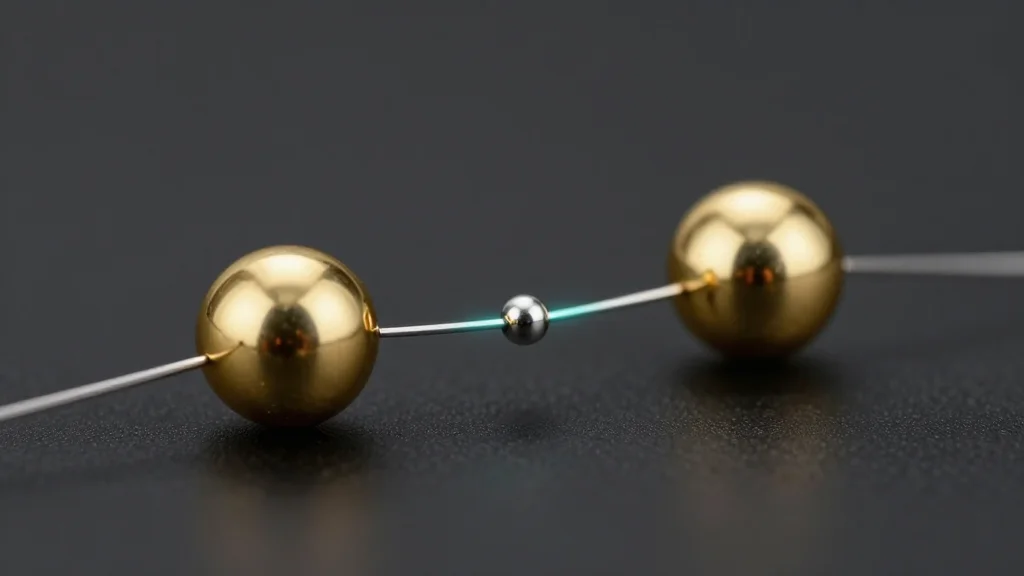
The study models a minimal Kitaev chain—two quantum dots linked by a superconducting segment—and introduces a magnetic S‑spin that couples via exchange interaction J. This perturbation triggers a spillover of the Majorana wave function, generating discrete subgap levels inside the superconducting gap. Crucially, the number of these levels follows 2S + 1 for half‑integer (fermionic) spins and 2S + 2 for integer (bosonic) spins, providing a direct spectroscopic fingerprint of the particle’s statistics. Because similar InSb nanowire devices with gate‑defined dots already exist, the proposal is experimentally accessible.
Beyond its fundamental appeal, the ability to read out spin statistics with a simple conductance measurement opens a new avenue for quantum sensing and device calibration. The authors also identify “environmentally induced protection,” where coupling to metallic leads can partially stabilize the PMM, suggesting that controlled dissipation may become a design tool rather than a flaw. If validated, such sensors could accelerate the development of Majorana‑based architectures by offering a low‑overhead testbed for material quality, spin manipulation, and readout schemes, thereby bridging the gap between laboratory prototypes and scalable quantum processors.
'Poor man's majoranas' can be used as quantum spin probes
Comments
Want to join the conversation?