Key Takeaways
- •Measured hBN defect intermediate state lifetime: 24 ns at room temperature
- •Optimized 150 ns delay boosted measurement contrast 26% and sensitivity 11%
- •2D hBN enables atomic‑scale defect placement, reducing sensor‑target distance
- •Findings pave way for faster, more accurate quantum sensors in medical diagnostics
- •Magnetic isotopes in hBN limit coherence, prompting further material engineering
Pulse Analysis
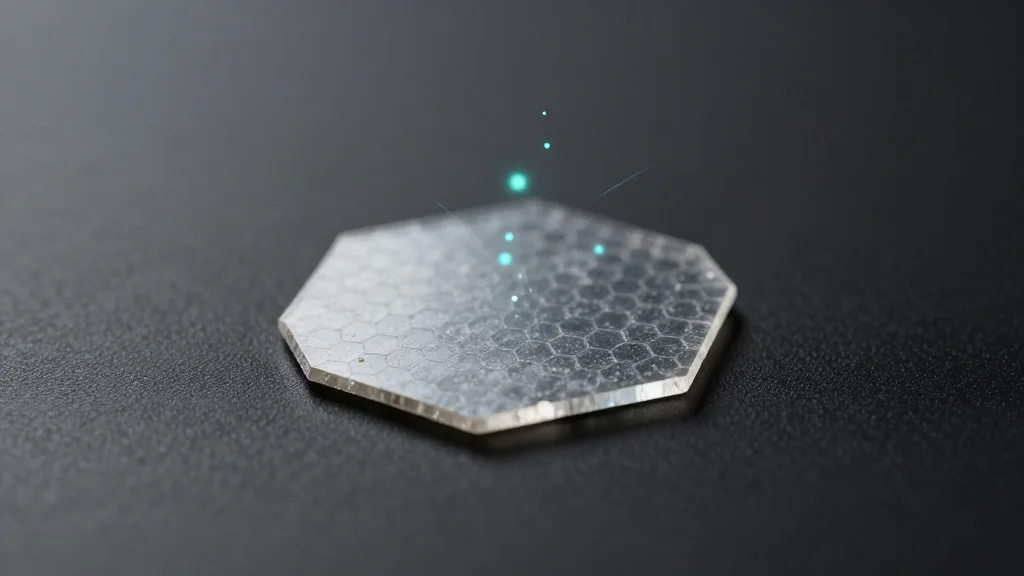
The precise measurement of a 24‑nanosecond metastable state in hexagonal boron nitride marks a milestone for quantum‑sensor engineering. While diamond has long dominated the field due to its robust three‑dimensional lattice, hBN’s two‑dimensional structure allows spin defects to be positioned with atomic precision just a few angstroms from the target. This proximity dramatically strengthens the magnetic interaction, a critical factor for sensor signal‑to‑noise ratios, and opens the door to room‑temperature operation—an advantage for scalable, field‑ready devices.
Beyond the material breakthrough, the Würzburg team demonstrated that timing is as crucial as material choice. By introducing a 150‑nanosecond pause between optical excitation and microwave manipulation, they cleared the defect’s “waiting room,” enabling a 26 % boost in measurement contrast and an 11 % gain in overall sensitivity. Such gains translate directly into higher resolution in applications ranging from atomic magnetometry to biomedical imaging, where detecting minute magnetic fields can reveal early disease markers. The ability to fine‑tune pulse sequences based on experimentally verified dynamics gives engineers a reliable design rule, reducing reliance on theoretical approximations.
Nevertheless, hBN’s promise is tempered by intrinsic challenges. The material consists entirely of magnetic isotopes, whose nuclear spins shorten coherence times compared with isotopically purified diamond. Overcoming this limitation will require advanced isotopic engineering or heterostructure designs that shield the quantum defects. As research progresses, investors and technology firms are watching closely; a viable hBN‑based sensor platform could reshape the quantum‑technology market, offering lower‑cost, high‑performance alternatives for next‑generation diagnostics, navigation, and industrial sensing solutions.
Precision boost for quantum sensor technology
Comments
Want to join the conversation?