Probing the Mind-Boggling Properties of a Superconductor that Shouldn't Exist
Key Takeaways
- •UTe2 regains superconductivity between 40‑70 Tesla after loss at ~10 Tesla
- •Cantilever method measures transverse magnetic susceptibility during sub‑second field pulses
- •Large transverse magnetic fluctuations act as pairing ‘glue’ for high‑field superconductivity
- •Technique adopted globally for defect‑free micro‑samples in extreme magnetic fields
- •Insights could guide future quantum computing and high‑field technology development
Pulse Analysis
Uranium ditelluride (UTe₂) has baffled physicists since its 2019 discovery because it defies conventional superconducting rules. While most superconductors lose zero‑resistance once a magnetic field is applied, UTe₂ vanishes around 10 Tesla, only to re‑appear between 40 and 70 Tesla. This re‑entrant behavior, confined to ultra‑low temperatures and precise crystal orientations, signals an unconventional pairing mechanism that cannot be explained by lattice vibrations alone. Understanding such anomalies is crucial for the broader class of quantum materials that could underpin next‑generation devices.
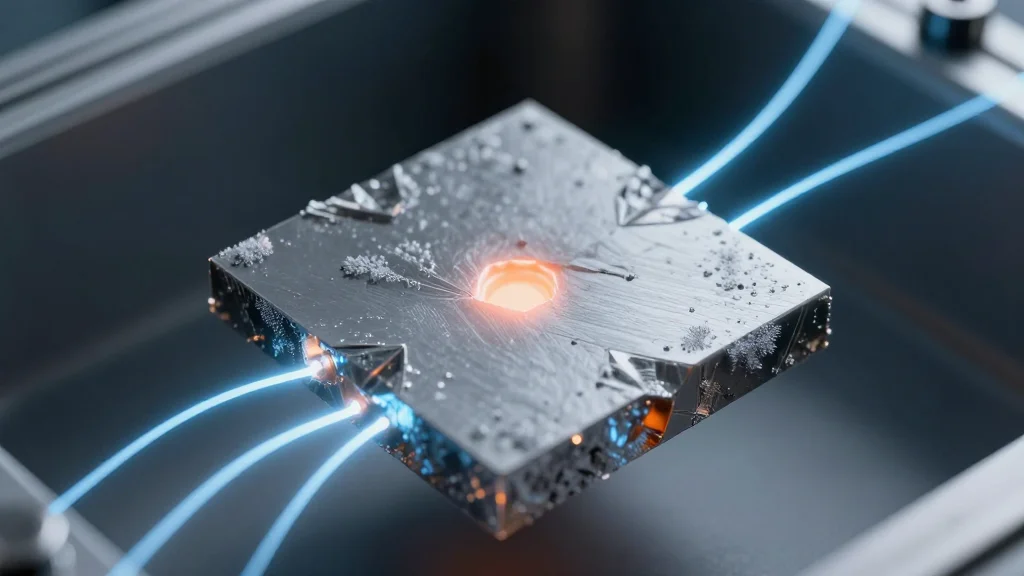
The breakthrough came from a new high‑field measurement technique developed by Valeska Zambra’s team at ISTA. By mounting a microscopic UTe₂ crystal on a cantilever and subjecting it to rapid magnetic pulses—ramping to 60 Tesla in a tenth of a second—the researchers could shake the sample and capture transverse magnetic susceptibility in real time. The data revealed a pronounced region of magnetic fluctuations, which the authors propose acts as the electron‑pairing "glue" enabling superconductivity under extreme fields. This approach overcomes previous limitations that required larger samples and slower field sweeps, offering a versatile tool for probing fragile quantum states.
Beyond the immediate scientific insight, the method’s adoption by high‑field facilities worldwide signals a shift in how researchers will interrogate exotic materials. By providing a direct window into magnetic dynamics at the brink of superconductivity, the technique accelerates the discovery pipeline from fundamental physics to practical applications. While commercial uses may still be years away, the knowledge gained could inform the design of robust quantum bits, high‑field magnets for medical imaging, and other technologies that rely on loss‑free electron transport. The UTe₂ story exemplifies how curiosity‑driven research can eventually translate into transformative innovations.
Probing the mind-boggling properties of a superconductor that shouldn't exist
Comments
Want to join the conversation?