Quantum Systems Lose Synchronisation Via Newly Observed ‘Phase Slips’

Key Takeaways
- •Quantum phase slips cause synchronization loss in superconducting resonators.
- •Detuning ratio Δ/D > 1 reduces phase‑slip diffusion below 0.5.
- •Keldysh path‑integral captures non‑Markovian effects in limit cycles.
- •Coupling strength matching relaxation rate eliminates stable phase exchange.
- •Findings impact atomic clocks and quantum communication reliability.
Pulse Analysis
Synchronization underpins everything from laser arrays to distributed quantum processors, yet quantum systems introduce a layer of fragility absent in classical devices. Recent theoretical work reveals that intrinsic quantum fluctuations generate phase slips—random jumps in the oscillator’s phase—that can dismantle coordinated motion even when coupling appears strong. By quantifying the ratio of phase‑slip diffusion to ambient noise, the study pinpoints a clear threshold: once the normalized detuning Δ/D surpasses unity, the system’s ability to maintain a shared rhythm collapses, mirroring classical divergence but driven by fundamentally quantum uncertainty.
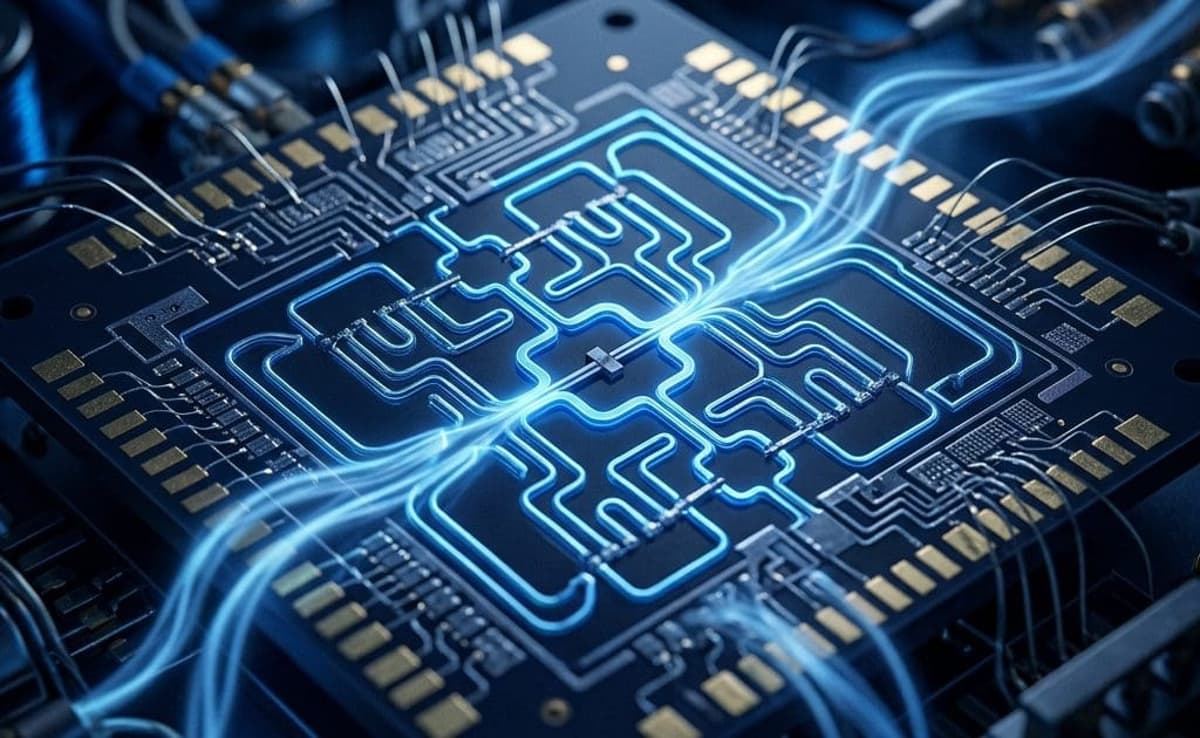
The authors employed a Keldysh path‑integral approach, a powerful technique for modeling non‑equilibrium quantum dynamics, to capture the full spectrum of trajectories that a limit‑cycle oscillator can explore. This formalism naturally incorporates non‑Markovian memory effects, which traditional Markovian master equations overlook. Simulations on superconducting resonators—tiny microwave cavities coupled via a voltage‑biased double quantum dot—demonstrated how increasing detuning reduces the diffusion constant σ₂⁻, confirming the theoretical prediction. Moreover, when the coupling strength D approaches the relaxation rate γ₁, phase exchange stalls entirely, underscoring the delicate balance between interaction strength and intrinsic dissipation.
Practically, these insights reverberate across high‑precision domains. Atomic clocks rely on exquisitely synchronized atomic transitions; quantum phase slips could introduce timing jitter that degrades accuracy. Similarly, quantum key distribution and other communication protocols demand coherent phase relationships between distant nodes, making them vulnerable to the same decoherence pathways. By exposing the limits of current synchronization models, the research prompts a reevaluation of device architectures and encourages the development of mitigation strategies—such as engineered reservoirs or adaptive feedback—to preserve coherence in the next generation of quantum technologies.
Quantum Systems Lose Synchronisation Via Newly Observed ‘phase Slips’
Comments
Want to join the conversation?