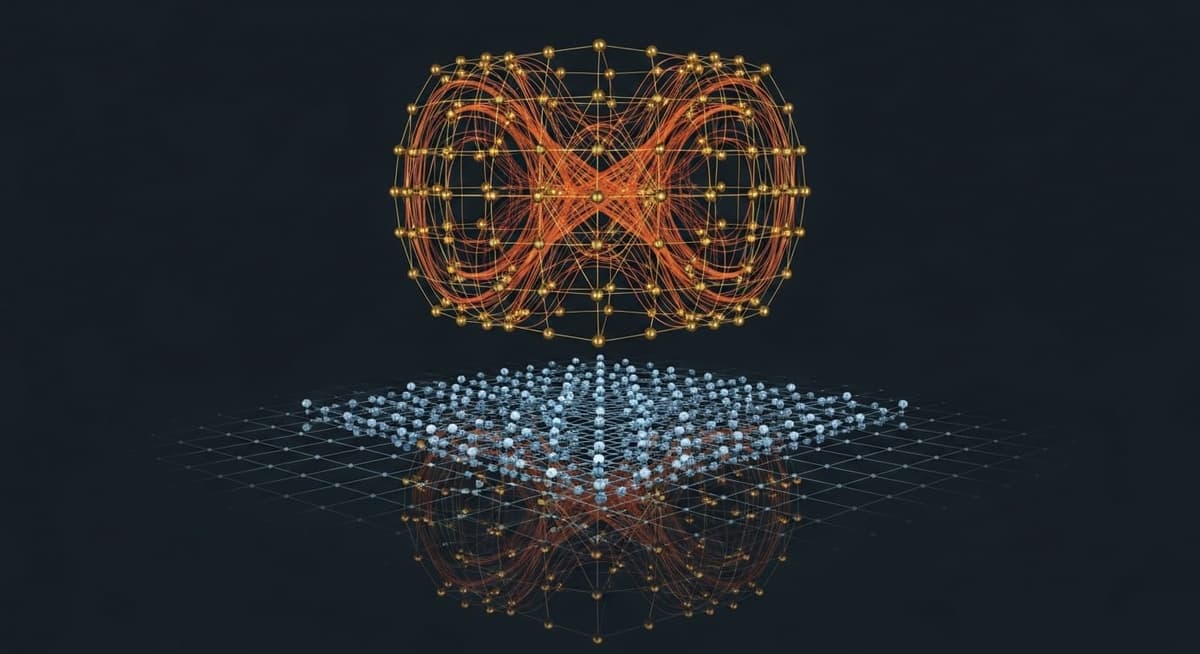
Quantum Walkers Reveal Stable Strategies for Novel Game Dynamics

Key Takeaways
- •Interacting quantum walkers generate non‑separable payoff functions
- •Stable Nash equilibria appear only with walker coupling
- •Interference terms drive strategic interdependence
- •Model bypasses externally defined rewards, using unitary dynamics
- •Potential to inspire quantum‑inspired algorithms for complex systems
Pulse Analysis
The study introduces a new class of "native" quantum games where the payoff structure is not imposed externally but emerges from the physics of interacting discrete‑time quantum walks. Traditional quantum‑game research maps classical scenarios onto quantum Hilbert spaces, requiring designers to specify reward matrices. By contrast, Ahmad’s team shows that the interference between walkers’ wavefunctions creates non‑separable payoffs at first order in the interaction strength, automatically linking players’ outcomes and satisfying Nash conditions without any artificial scaffolding.
Technical analysis reveals that the coupling of distinguishable walkers produces interference terms in the joint probability distribution, which act as the engine of strategic coupling. The analytical decomposition isolates these terms, demonstrating that they are responsible for the emergence of stable equilibria across competitive, cooperative and asymmetric settings. Numerical simulations back the theory, showing that when the walkers are uncoupled the system lacks any equilibrium, while even modest interaction yields stationary points that meet Nash criteria. This provides a clear, physics‑driven mechanism for strategic interdependence, offering a tractable platform for simulating game dynamics with quantum‑computational tools.
Beyond the immediate physics community, the implications ripple into fields that grapple with emergent behavior. By harnessing quantum‑inspired dynamics, researchers can design algorithms that capture complex interdependencies in financial markets, evolutionary biology or multi‑agent AI systems—domains where classical models often miss subtle, collective effects. While the current model is limited to two players and perturbative analysis, it lays the groundwork for scaling to multi‑player scenarios and more robust numerical methods, potentially reshaping how strategic interactions are modeled in the quantum era.
Quantum Walkers Reveal Stable Strategies for Novel Game Dynamics
Comments
Want to join the conversation?