Key Takeaways
- •Meter‑scale rotating tank mimics equator‑to‑pole temperature gradient
- •Energy spectrum matches real atmospheric observations across scales
- •Cascade intensity varies with temperature, contrary to existing models
- •Findings could refine climate models for Earth and exoplanets
Pulse Analysis
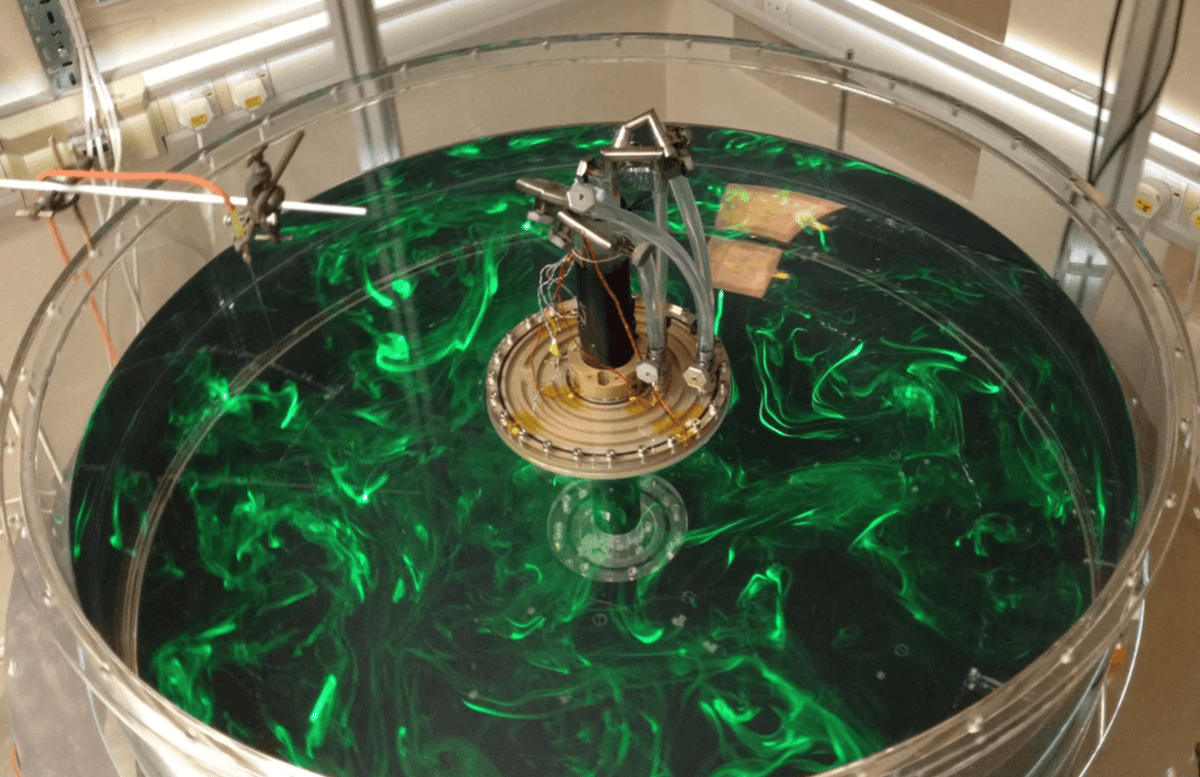
Laboratory analogs have long helped scientists probe atmospheric dynamics that are difficult to observe directly. By scaling down the planet’s circulation into a meter‑scale rotating annular tank, researchers can control heating, cooling, and rotation with precision. The experiment by Ding et al. uses a water‑glycerol mixture to replicate the fluid viscosity of air, while the heated outer rim and cooled central pipe create a temperature gradient analogous to equatorial warming and polar cooling. Such setups bridge the gap between theoretical fluid‑dynamics equations and real‑world weather patterns, offering a repeatable platform for testing hypotheses about energy and vorticity transfer.
The team measured the kinetic‑energy spectrum across a range of rotation rates and found a steep drop at large length scales followed by a flatter tail at smaller scales—an exact replica of the atmospheric energy cascade observed by satellites. Unexpectedly, the cascade’s intensity shifted with temperature changes, a behavior not captured by current general‑circulation models. This temperature dependence suggests that thermal stratification may play a more active role in directing energy from large‑scale motions to turbulence than previously thought, prompting a re‑examination of the assumptions underlying many climate simulations.
If the temperature‑driven cascade holds true for Earth’s atmosphere, incorporating it could improve the fidelity of weather forecasts and long‑term climate projections. Moreover, the findings extend to planetary bodies with different thermal profiles, offering a new tool for interpreting data from Mars, Venus, or exoplanets with exotic atmospheres. Future work will likely explore varying fluid compositions, rotation speeds, and heating configurations to map the full parameter space, fostering collaboration between experimental physicists, atmospheric scientists, and climate modelers.
Recreating Atmospheres
Comments
Want to join the conversation?