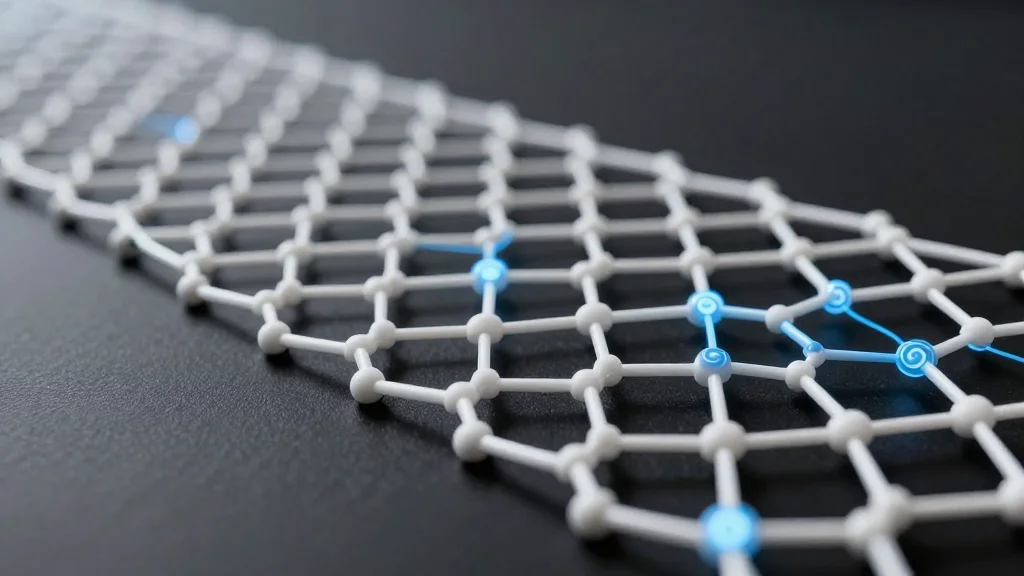
Researchers Steer Electron Spin Ballistically in Graphene
Key Takeaways
- •Ballistic spin transport observed over micrometer distances in graphene.
- •Spin signals remain coherent up to 300 K (room temperature).
- •Transverse magnetic focusing enables lens-like steering of spin‑polarised electrons.
- •Gate voltage tunes spin signal magnitude and polarity.
- •No spin‑orbit coupling required, simplifying spintronic device design.
Pulse Analysis
Spintronics has long promised faster, energy‑efficient computing by exploiting electron spin rather than charge, but practical implementations have been hampered by material constraints and temperature limits. Graphene, with its exceptional carrier mobility and weak intrinsic spin‑orbit interaction, emerges as an ideal platform for preserving spin coherence. The recent study leverages these properties, showing that electrons can travel without scattering—ballistically—while retaining their spin information, a combination rarely achieved in solid‑state systems.
The research team employed transverse magnetic focusing, a technique that bends electron paths in a magnetic field much like an optical lens refracts light. By integrating ferromagnetic cobalt contacts, they injected spin‑polarised electrons and detected distinct focusing peaks that directly encode spin orientation. Crucially, the magnitude and even the sign of these peaks could be modulated with a simple back‑gate voltage, effectively turning the spin signal on, off, or reversing it. This gate‑controlled spin modulation persisted from cryogenic 25 K up to ambient 300 K, demonstrating that the phenomenon is robust enough for real‑world device environments.
For industry, the ability to steer and manipulate spin without invoking strong spin‑orbit coupling simplifies device architecture and reduces fabrication complexity. It revives concepts like the Datta‑Das spin‑field‑effect transistor, but replaces the reliance on Rashba‑type interactions with electron‑optics control. As graphene production scales and integration techniques mature, these findings could accelerate the rollout of spin‑based interconnects, memory elements, and quantum‑information components, positioning graphene as a cornerstone material in the next generation of low‑power electronics.
Researchers steer electron spin ballistically in graphene
Comments
Want to join the conversation?