Key Takeaways
- •Simulations remain coherent up to 1,000 agents.
- •At 50,000 agents, groups fragment into smaller clusters.
- •Simple visual/hydrodynamic cues drive realistic collective motion.
- •Findings inform swarm robotics and large-scale crowd modeling.
- •Scaling limits reveal computational and behavioral challenges.
Pulse Analysis
The recent study from H. Hang and colleagues demonstrates that a modest set of visual and hydrodynamic rules can generate digital fish that move in patterns indistinguishable from real‑world schools. By encoding only a few interaction parameters—such as alignment, attraction, and repulsion—the simulated agents reproduce classic schooling and milling formations with as few as one hundred individuals. This minimalist approach underscores how complex collective dynamics often arise from simple local cues, a principle that has long guided biological modeling and now offers a scalable template for virtual ecosystems and synthetic biology.
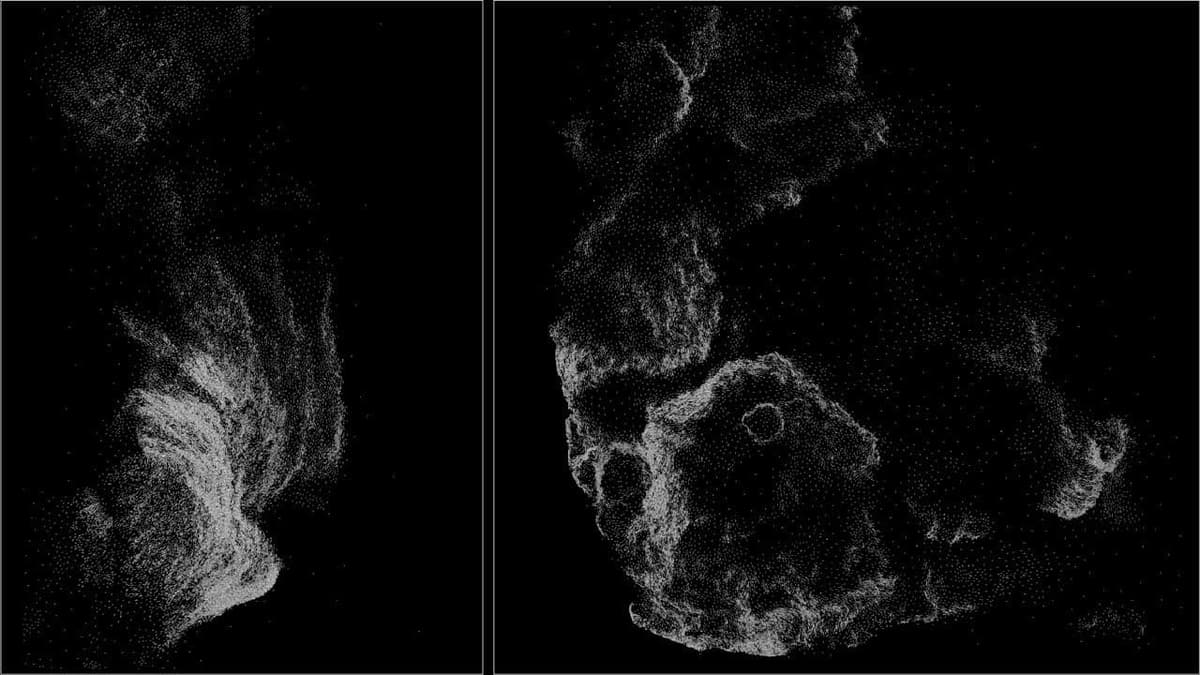
When the researchers pushed the model to one thousand agents, the virtual school retained cohesion, displaying coordinated turns and stable milling around a central point. However, at fifty thousand agents the emergent order collapsed; the swarm fractured into numerous micro‑clusters that drifted independently. The breakdown highlights a scaling threshold where the simple rule set can no longer reconcile global information flow, leading to fragmentation. Understanding this limit is crucial for developers of large‑scale simulations, as it signals when additional communication layers or adaptive parameters become necessary to preserve collective intelligence.
The implications extend beyond academic curiosity. Engineers designing swarming drones, autonomous underwater vehicles, or crowd‑control algorithms can leverage the study’s insight that minimal interaction rules suffice only up to a certain population density. By incorporating hierarchical signaling or dynamic rule adaptation, future systems may avoid the fragmentation observed at fifty thousand digital fish. Moreover, the research offers a benchmark for testing high‑performance computing platforms, as rendering tens of thousands of interacting agents stresses both processing power and network latency. As virtual environments grow richer, mastering scale will be a decisive factor for realistic, real‑time simulations.
Schooling at Scale
Comments
Want to join the conversation?