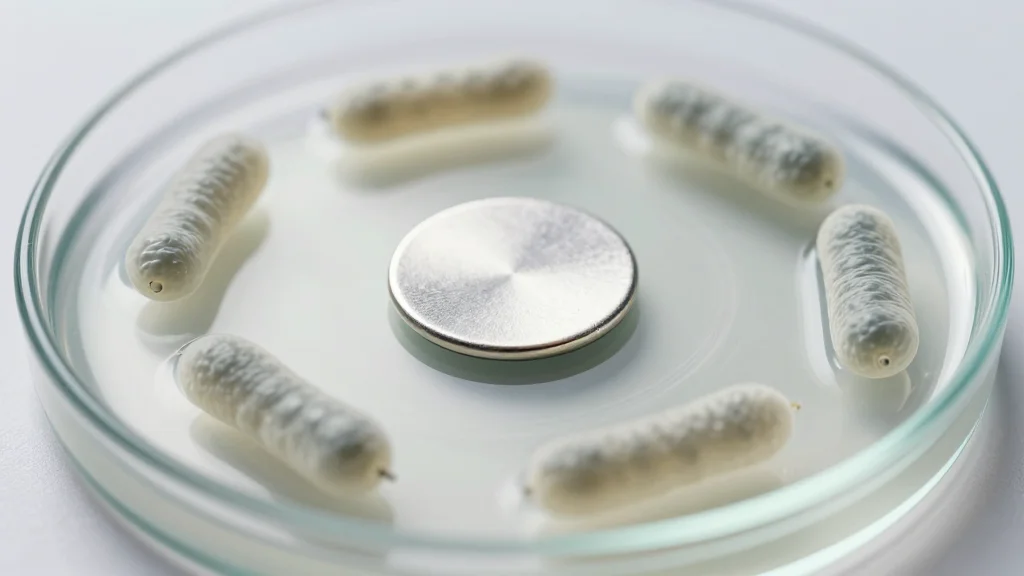
Scientists Discover How Bacteria Rotate Tiny Pucks and Create Unusual Materials
Key Takeaways
- •E. coli generate torque that spins symmetric micro‑discs
- •Rotation occurs without physical contact, driven by fluid swirl
- •Faster spin achieved with multi‑compartment disc designs
- •Effect works in any confined micro‑environment
- •Potential for contactless micro‑engines in medicine and sustainability
Pulse Analysis
Scientists at the Institute of Science and Technology Austria have revealed a previously hidden hydrodynamic mechanism by which swimming *E. coli* can set symmetric micro‑discs spinning without any mechanical contact. Published in *Nature Physics*, the study builds on earlier work that showed bacteria could rotate asymmetric gears, but it overturns the assumption that shape asymmetry is required. By immersing 3‑D printed hockey‑puck‑like discs in an active bacterial bath, the researchers observed consistent clockwise rotation, demonstrating a universal torque source generated by the microbes themselves.
The effect stems from the counter‑rotation of a bacterium’s body and its flagella, which creates a swirling flow field that exerts torque on nearby surfaces. When confined beneath a disc, the fluid swirl translates into a net rotational force on the disc’s top wall, while the disc’s centre remains stationary. Experiments showed that adding four inward‑pointing compartments to the puck amplified the spin rate, confirming that confinement geometry can tune the hydrodynamic coupling. Crucially, a single‑compartment disc began rotating as soon as a single cell passed, proving contact is unnecessary.
Because the torque is cumulative and independent of object shape, the phenomenon could power a new class of contactless micro‑engines for drug‑delivery capsules, lab‑on‑a‑chip mixers, or self‑assembling soft materials. In medical contexts, harnessing bacterial‑driven rotation may enable targeted disruption of biofilms, a major factor in antibiotic resistance. From a sustainability perspective, the ability to convert microbial motion into mechanical work offers a low‑energy route to fabricate structured materials without external power sources. Ongoing research will likely explore scaling the effect, integrating it with synthetic biology circuits, and deploying it in real‑world micro‑fluidic platforms.
Scientists discover how bacteria rotate tiny pucks and create unusual materials
Comments
Want to join the conversation?