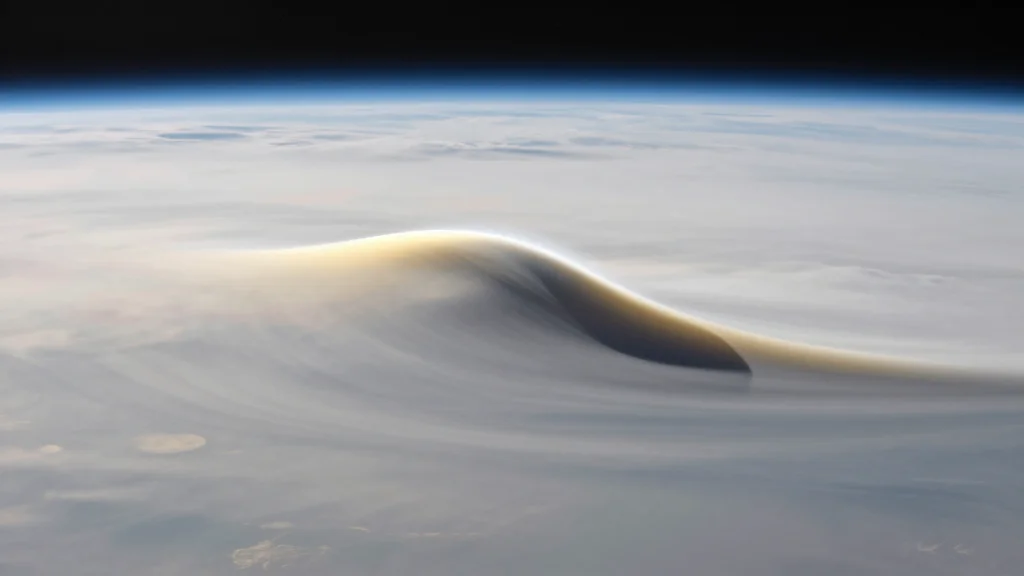
Solar System's Largest Hydraulic Jump Drives Massive Cloud Waves Across Venus
Key Takeaways
- •6,000 km cloud front on Venus caused by largest known hydraulic jump.
- •Sudden slowdown of Kelvin wave creates updraft that lifts sulfuric vapor.
- •Hydraulic jump links horizontal flow to vertical cloud formation, sustaining super‑rotation.
- •Current Venus GCMs lack this process; new models required.
- •Similar hydraulic jumps may exist on Mars, influencing future exploration.
Pulse Analysis
A hydraulic jump—where a fast, shallow flow abruptly becomes slower and deeper—is a familiar sight in kitchen sinks, but on Venus it spans 6,000 km, dwarfing any Earthly example. The University of Tokyo team used high‑resolution fluid‑dynamic simulations to capture this planetary‑scale transition, showing that an eastward Kelvin wave in the lower cloud deck suddenly decelerates, generating a powerful updraft that lofts sulfuric‑acid vapor into the upper layers. The resulting condensation creates a dense, dark cloud front that sweeps around the equator, a phenomenon first imaged by Japan’s Akatsuki orbiter.
The hydraulic jump provides a missing link in Venus’s atmospheric puzzle, particularly its notorious super‑rotation, where cloud layers circle the planet 60 times faster than the surface. By converting horizontal kinetic energy into vertical motion, the jump helps redistribute momentum, sustaining the rapid eastward winds. Existing global circulation models (GCMs) omit this process, leading to discrepancies between simulated and observed cloud dynamics. Incorporating the jump into next‑generation GCMs will refine predictions of temperature, wind patterns, and chemical transport, essential for designing entry, descent, and landing systems for future probes.
Beyond Venus, the physics of large‑scale hydraulic jumps may apply to other planetary atmospheres, including Mars, where thin CO₂ air and seasonal dust storms could trigger similar flow instabilities. Recognizing such mechanisms expands our toolkit for interpreting remote‑sensing data and improves the fidelity of climate models across the solar system. For mission planners, accounting for abrupt vertical transport events can influence instrument placement, communication windows, and hazard assessments, ultimately enhancing the scientific return of upcoming exploratory missions.
Solar system's largest hydraulic jump drives massive cloud waves across Venus
Comments
Want to join the conversation?