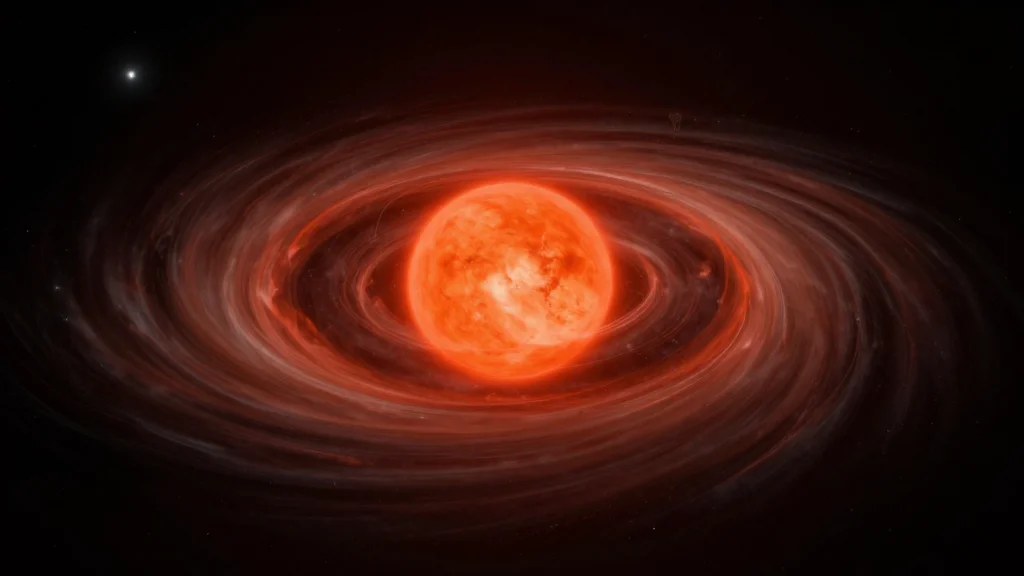
Study Reveals Growth Spurt of Massive Stars in Extreme Galactic Center
Key Takeaways
- •Massive O‑type protostar G359.44‑0.102 observed in Sagittarius C.
- •Keplerian disk, envelope, and streams drive rapid mass accumulation.
- •Nitrogen molecules concentrate centrally; oxygen molecules spread outward.
- •Spiral accretion streams confirmed via particle‑trajectory modeling.
- •Disk‑mediated star formation appears universal despite extreme CMZ turbulence.
Pulse Analysis
102 in the Central Molecular Zone (CMZ) provides a rare, high‑resolution glimpse of massive star birth under conditions of extreme turbulence, high pressure, and strong magnetic fields. By leveraging ALMA’s sub‑millimeter capabilities, researchers traced a classic Keplerian disk surrounded by an infalling envelope and identified spiral accretion streams that funnel material onto the protostar.
\n\nBeyond the structural insight, the study’s chemical analysis uncovers a clear segregation of molecular species: nitrogen‑bearing compounds cluster in a compact inner region, while oxygen‑bearing molecules form a more diffuse halo. Such differentiation offers clues about temperature gradients, shock chemistry, and the timeline of disk evolution. \n\nThe broader implication is a shift toward a more universal framework for massive star formation.
If accretion disks can operate independently of their macroscopic environment, models of galaxy‑scale star formation—especially in starburst nuclei and high‑redshift galaxies—must account for efficient, disk‑driven growth despite chaotic surroundings. Future surveys targeting other CMZ cores and extragalactic analogs will test the scalability of these findings, potentially refining our understanding of how the most massive stars shape the chemical and dynamical evolution of galaxies.
Study reveals growth spurt of massive stars in extreme galactic center
Comments
Want to join the conversation?