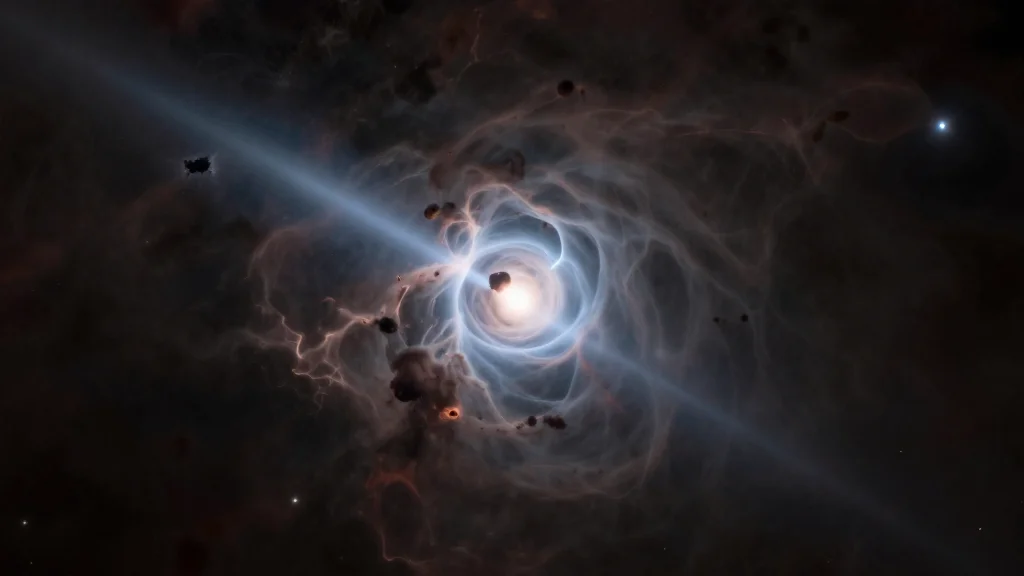
Study Reveals the First Galactic Population of Gamma-Ray Emitting Protostars
Key Takeaways
- •33 protostars linked to Fermi gamma‑ray sources, forming a new class
- •Jets collide with ambient gas, accelerating protons to near‑light speeds
- •Gamma‑Loud Protostars provide a natural laboratory for cosmic‑ray studies
- •Study bridges thermal and non‑thermal processes in early stellar evolution
Pulse Analysis
The formation of stars has long been viewed through a thermal lens, with protostars radiating primarily heat as they accrete material from their natal clouds. Recent observations, however, have hinted at more extreme processes occurring within the powerful jets that protostars eject at hundreds of kilometres per second. By confirming that these jets can accelerate particles to relativistic speeds, the new research expands the astrophysical toolkit for probing the earliest stages of stellar birth, linking them directly to high‑energy phenomena traditionally reserved for supernovae and black holes.
The breakthrough emerged from a systematic cross‑reference of the Fermi space telescope’s most extensive list of unassociated gamma‑ray sources with the Red MSX Survey of young stellar objects. Thirty‑three spatial coincidences stood out, providing the first statistically robust sample of gamma‑ray bright protostars. Gamma rays serve as a unique tracer of hadronic acceleration, allowing scientists to infer the presence of fast‑moving protons that would otherwise be invisible. This methodological synergy showcases how big‑data approaches and multi‑wavelength catalogs can uncover hidden astrophysical populations, reinforcing the value of collaborative data mining across observatories.
Beyond its scientific intrigue, the discovery has practical implications for the high‑energy astrophysics community and related technology sectors. Understanding natural particle accelerators informs the design of next‑generation detectors and informs models that predict radiation environments for space missions. Moreover, Gamma‑Loud Protostars become a new laboratory for testing theories of cosmic‑ray propagation, potentially guiding future investments in gamma‑ray observatories and computational modeling platforms. As the field moves toward integrated, multi‑messenger astronomy, these protostars could serve as a bridge between stellar physics, particle astrophysics, and emerging commercial space ventures.
Study reveals the first galactic population of gamma-ray emitting protostars
Comments
Want to join the conversation?