Superconductivity That Shouldn’t Exist? ISTA Researchers Dissect the Properties of a Strange Quantum Material

Key Takeaways
- •UTe₂ regains superconductivity between 40‑70 Tesla after loss at 10 Tesla
- •ISTA's pulsed‑field method reaches 60 Tesla in a tenth‑second pulse
- •Transverse magnetic susceptibility identified as electron‑pairing “glue” in UTe₂
- •Technique works on sub‑grain‑size, defect‑free samples, enabling precise measurements
- •Labs worldwide adopt the method, accelerating quantum‑material research
Pulse Analysis
Uranium ditelluride (UTe₂) has become a poster child for unconventional superconductors since its 2019 discovery, defying the textbook rule that magnetic fields suppress zero‑resistance states. Instead, after losing superconductivity near 10 Tesla, the material astonishingly re‑enters a superconducting phase at fields exceeding 40 Tesla, a phenomenon known as re‑entrant superconductivity. This behavior has puzzled theorists because it suggests an entirely different pairing mechanism that can survive, or even thrive, under extreme magnetic conditions, hinting at new physics beyond the Bardeen‑Cooper‑Schrieffer framework.
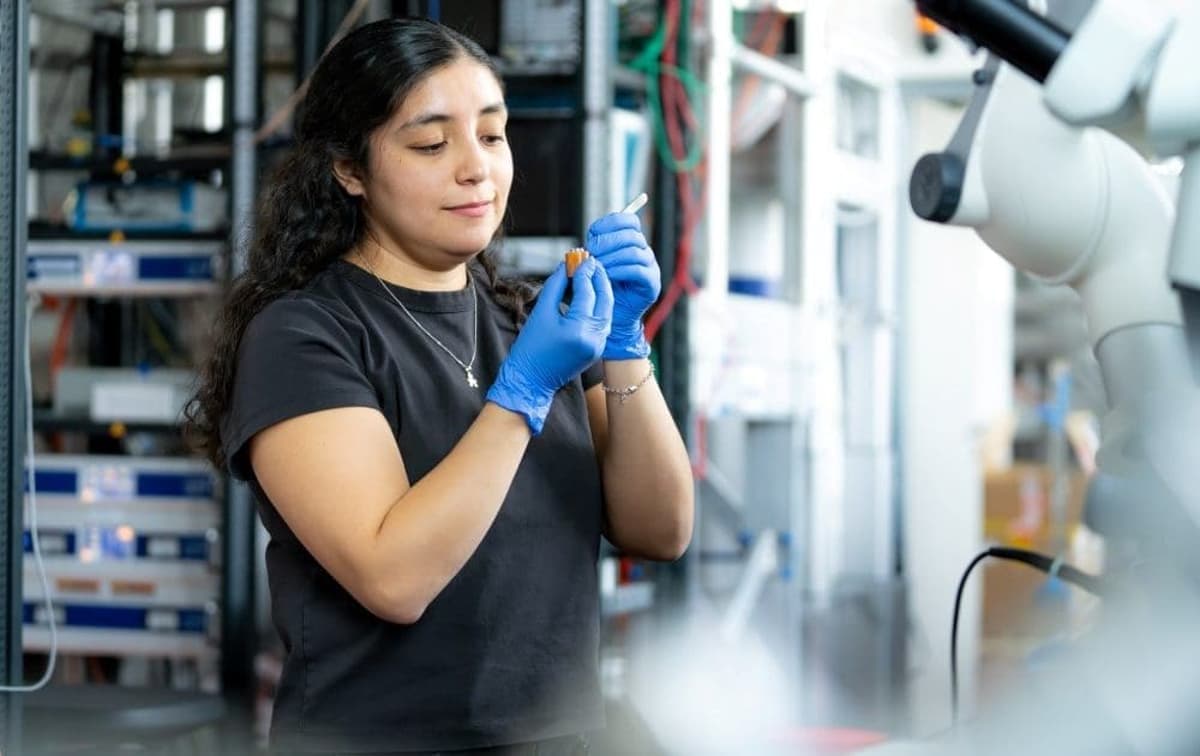
To crack this mystery, ISTA scientists led by Valeska Zambra and Kimberly Modic engineered a pulsed‑field technique that subjects microscopic UTe₂ crystals to magnetic spikes up to 60 Tesla within a tenth of a second. By mounting samples smaller than a grain of sand on a cantilever and “shaking” them with rapidly changing fields, the team measured transverse magnetic susceptibility—a property that quantifies how the material magnetizes perpendicular to the applied field. The data revealed a pronounced susceptibility peak that likely serves as the glue binding electrons into Cooper pairs at high fields, providing the first experimental foothold for theories that attribute re‑entrance to magnetic fluctuations.
The broader impact of this breakthrough extends far beyond a single compound. The method’s precision and scalability have already attracted interest from high‑field facilities across Europe, Asia, and North America, promising faster validation of exotic quantum states in other candidate materials. As researchers integrate this technique into their toolkits, the community moves closer to engineering superconductors that operate under conditions previously thought impossible, potentially unlocking ultra‑efficient power transmission, high‑field magnets for medical imaging, and components for quantum computers. The convergence of novel measurement technology and fundamental insight marks a pivotal step toward harnessing unconventional superconductivity for real‑world applications.
Superconductivity That Shouldn’t Exist? ISTA researchers dissect the properties of a strange quantum material
Comments
Want to join the conversation?