Key Takeaways
- •Lorentz force drives bubble rotation without mechanical blades
- •Magnetic field orientation determines clockwise swirl direction
- •Voltage variation changes bubble swirl intensity and speed
- •Blade‑less mixing offers energy‑efficient fluid control
- •Findings could impact electrolysis reactor design
Summary
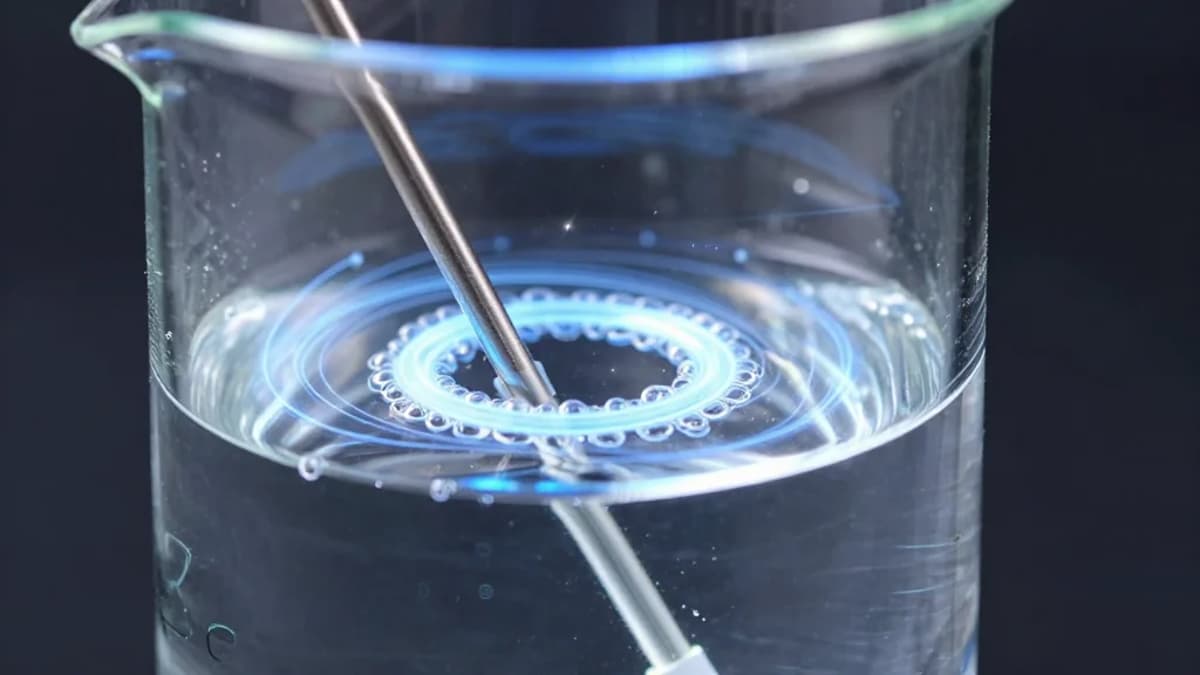
Researchers observed a ring of hydrogen bubbles rising and rotating clockwise during electrolysis, despite the absence of any fan blades. The rotation is caused by a Lorentz force generated by the interaction of electric currents and magnetic fields in the experimental setup. By adjusting voltage and magnetic field orientation, the team could control the swirl’s speed and direction. This blade‑less fluid motion demonstrates a novel way to manipulate flow in conductive liquids.
Pulse Analysis
The phenomenon of rotating hydrogen bubbles emerges from the Lorentz force, a fundamental electromagnetic interaction where a current‑carrying fluid experiences a perpendicular force in a magnetic field. In the described experiment, electrodes sandwiched between permanent magnets create a localized magnetic flux, while the electrolysis current supplies the necessary charge flow. The resulting cross‑product of magnetic field and current vectors imparts a torque on the conductive electrolyte, causing the bubble plume to spin without any mechanical agitator. This insight bridges fluid dynamics and electromagnetism, highlighting how subtle field configurations can generate macroscopic flow patterns.
Beyond the laboratory curiosity, blade‑less bubble rotation presents practical advantages for industrial electrolysis and related processes. Traditional mixing relies on impellers or pumps, which consume significant power and introduce wear points. By leveraging electromagnetic forces, operators can induce turbulence and enhance mass transfer while minimizing mechanical components. Adjusting voltage levels directly tunes the current density, allowing precise control over swirl intensity and bubble rise rate. Such tunability could improve hydrogen production efficiency, reduce electrode fouling, and enable scalable designs for renewable energy storage systems.
The broader implications extend to any application involving conductive fluids, from metal casting to wastewater treatment. Engineers can now consider magnetic field placement and current pathways as design variables for fluid manipulation, opening avenues for compact, silent, and energy‑efficient reactors. As the push for greener technologies accelerates, integrating Lorentz‑driven mixing could lower operational costs and simplify maintenance, positioning electromagnetic flow control as a competitive alternative to conventional mechanical methods.
Comments
Want to join the conversation?