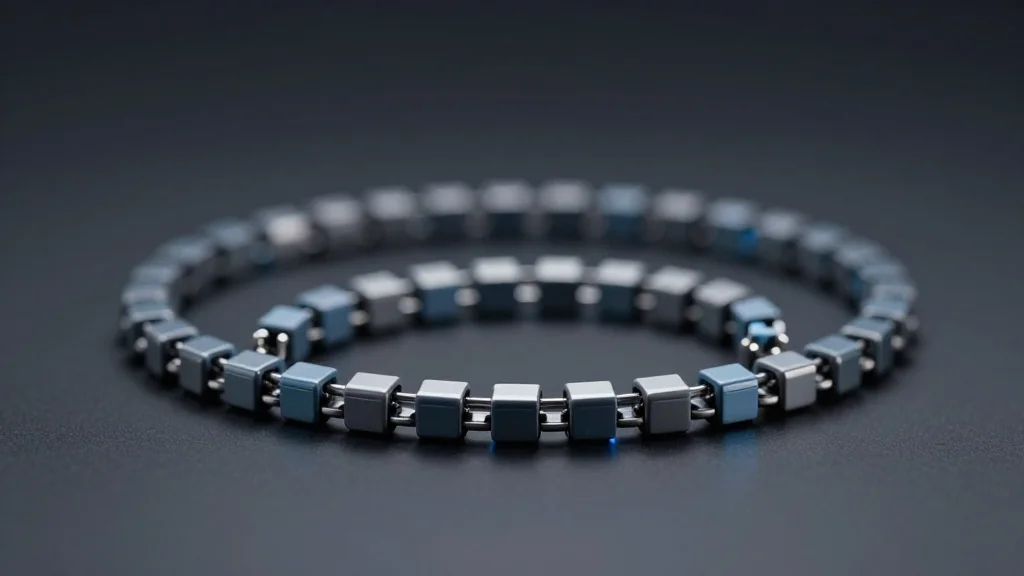
Synthetic Worm-Like Metamaterials that Learn, Adapt and Evolve Like Living Systems
Key Takeaways
- •Motorized hinges learn, forget, and toggle shapes autonomously
- •No central controller; each hinge communicates locally
- •Enables grasping, locomotion, and shape-shifting tasks
- •Future work targets dynamic gait learning and stochastic adaptation
- •Distributed learning expands soft robotics and adaptive material applications
Pulse Analysis
The emergence of learning metamaterials marks a shift from static engineering to materials that behave like living tissue. Conventional solids respond predictably to stress, while robots rely on pre‑programmed control loops. By embedding microcontrollers and torque‑generating hinges directly into an elastic chain, researchers have created a substrate that can modify its own stiffness and geometry through experience. This distributed intelligence mirrors how cells remodel themselves, opening a pathway for structures that adapt in real time to unpredictable forces or tasks. Such capability could revolutionize adaptive infrastructure and biomedical implants.
Each hinge functions as an independent learning node, measuring rotation, storing a short‑term memory of past motions, and exchanging state information with adjacent units. When a collective shape is reinforced, the hinges adjust their torque output, effectively ‘training’ the chain to adopt that configuration on demand. Because the algorithm runs locally, the system tolerates single‑point failures and scales without a central processor. This architecture aligns with soft‑robotics trends that favor compliance, modularity, and on‑board adaptation, promising applications ranging from reconfigurable grippers to shape‑changing aerospace panels. The low‑latency communication also enables rapid reconfiguration during operation.
Looking ahead, the team aims to extend learning beyond static shapes toward time‑dependent gaits such as crawling or rolling, and to incorporate stochastic learning that thrives under noisy conditions. If successful, industries ranging from manufacturing to defense could deploy structures that self‑optimise for terrain, load distribution, or stealth profiles without human re‑programming. Challenges remain in power budgeting, durability of micro‑actuators, and scaling the communication protocol to larger assemblies. Commercialization will depend on integrating energy‑harvesting modules to sustain autonomous cycles. Nonetheless, the proof‑of‑concept demonstrates that distributed, brain‑less learning can endow physical matter with a degree of autonomy previously reserved for software.
Synthetic worm-like metamaterials that learn, adapt and evolve like living systems
Comments
Want to join the conversation?