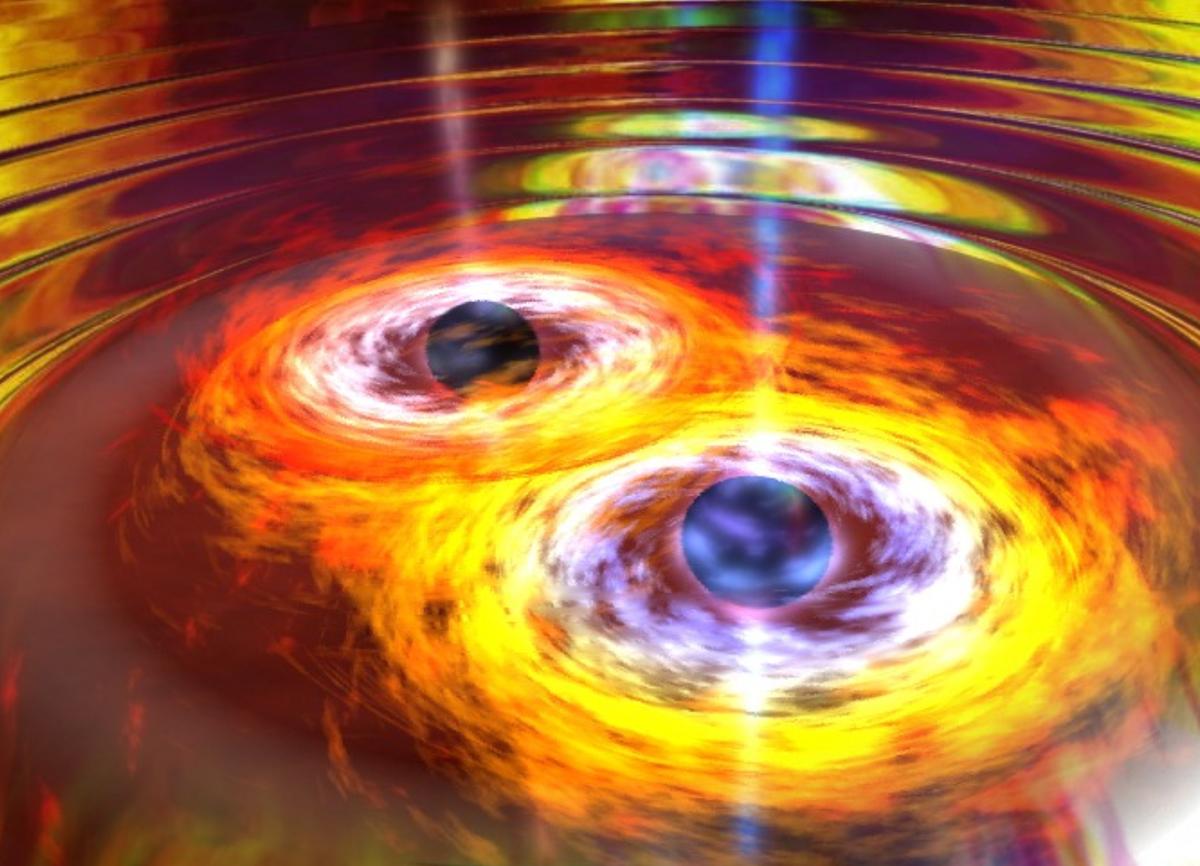
The Universe’s Most Wanted Black Holes Finally Have an Alibi
Key Takeaways
- •GW231123 merges 137 M☉ + 103 M☉ black holes, highest spins measured
- •Both masses sit inside the pair‑instability mass gap (≈60‑130 M☉)
- •Authors argue they are primordial black holes grown by long‑term accretion
- •Model predicts ~20 similar LVK O5 events with correlated mass‑spin patterns
- •Detection of high‑redshift mergers would strongly support the primordial scenario
Pulse Analysis
The discovery of GW231123 has sent shockwaves through the astrophysics community because its component masses—137 and 103 times that of the Sun—lie squarely in the pair‑instability mass gap, a range where conventional stellar evolution predicts no black holes can form. Even more striking, the measured dimensionless spins of 0.9 and 0.8 set a new record for gravitational‑wave sources, challenging existing models that tie high spin to binary evolution after stellar collapse. This tension has revived interest in exotic formation channels that bypass the gap entirely.
In the new study, De Luca, Franciolini and Riotto argue that the two black holes are primordial, born from density fluctuations in the infant Universe. Over billions of years, each object would have accreted surrounding gas and dark‑matter, a process that simultaneously increases mass and transfers angular momentum, spinning the holes up to near‑maximal rates. Their calculations show that modest accretion can raise a near‑static seed to a spin of 0.9, while dark‑matter halos act as catalysts, boosting the inflow. The model skirts the edge of existing X‑ray and cosmic‑microwave‑background constraints, making it testable with the next data release.
Looking ahead, the authors outline three clear observational avenues. The ongoing LVK O5 run should reveal roughly twenty events with a distinctive mass‑spin correlation if primordial black holes dominate the high‑mass tail. The forthcoming Einstein Telescope will probe redshifts beyond 15, where stellar progenitors cannot exist, potentially catching mergers of ancient primordial pairs. Finally, the accretion disks that spin up these black holes could produce brief X‑ray or gamma‑ray flares during the final inspiral, offering a multi‑messenger signature. Confirmation would reshape our understanding of black‑hole demographics and provide a rare glimpse into conditions moments after the Big Bang.
The Universe’s Most Wanted Black Holes Finally Have an Alibi
Comments
Want to join the conversation?