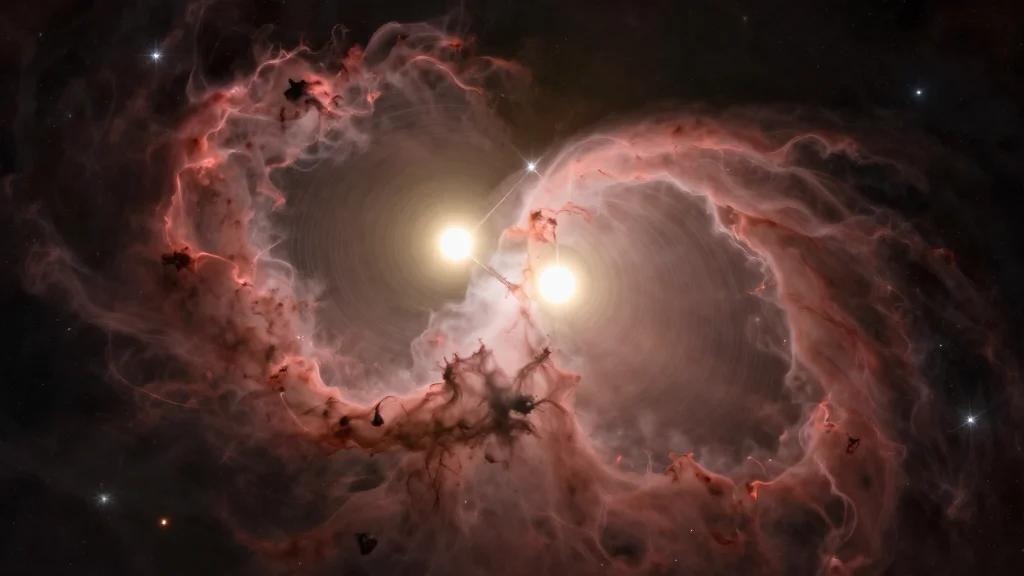
Orbital Dances Unlock True Masses of Orion's Young Stars
Why It Matters
Accurate stellar masses are the cornerstone for refining star‑formation theories and predicting planetary system outcomes. The new measurements provide a benchmark that can recalibrate evolutionary models used across astrophysics.
Key Takeaways
- •VLBA measured dynamical masses of Orion young binaries with sub‑milliarcsecond precision
- •Direct mass measurements expose discrepancies in standard pre‑main‑sequence evolution models
- •Hidden close companions identified, expanding known multiplicity in star‑forming regions
- •Strong magnetic activity observed in relatively massive young stars
- •Precise masses turn Orion into a laboratory for testing star‑formation theories
Pulse Analysis
Stellar mass dictates a star's luminosity, lifespan, and the elements it forges, making it a fundamental parameter for any astrophysical model. Yet, for stars still embedded in their natal clouds, conventional optical and infrared techniques struggle to pierce the dense dust. Radio interferometry, particularly the Very Long Baseline Array, sidesteps this obstacle by operating at wavelengths that dust cannot block, delivering angular resolutions finer than a milliarcsecond. This capability transforms Orion’s obscured nurseries into observable laboratories, where individual stellar motions can be traced over months.
In the recent DYNAMO‑VLBA campaign, researchers targeted a curated sample of Orion binaries, recording their positions across multiple epochs at 5 GHz. By fitting orbital trajectories to these precise astrometric points, they derived the true masses of each component directly from Newtonian dynamics. When compared to widely used pre‑main‑sequence evolutionary tracks, several objects aligned well, while at least one displayed a stark mass‑luminosity mismatch, hinting at gaps in current theory. The survey also revealed tight, previously unseen companions and documented sustained magnetic activity in stars up to a few solar masses, phenomena that influence accretion and early planetary disk evolution.
These findings ripple beyond Orion. With reliable mass benchmarks, astronomers can recalibrate models that predict how young stars accrete material, launch jets, and seed planetary systems. The ability to identify hidden multiplicity reshapes estimates of stellar population statistics, affecting calculations of galactic star‑formation rates. As radio arrays expand and integrate with upcoming facilities like the ngVLA, the methodology demonstrated here will likely become a standard tool for probing the earliest stages of stellar and planetary birth across the Milky Way.
Orbital dances unlock true masses of Orion's young stars
Comments
Want to join the conversation?
Loading comments...