100-Year-Old Assumption About the Universe May Soon Be Overturned
Why It Matters
A shift away from the cosmological principle would reshape theories of dark energy, inflation, and the universe’s ultimate fate, prompting a redesign of predictive models used by academia and industry.
Key Takeaways
- •Recent surveys detect density fluctuations beyond expected cosmic variance.
- •CMB anomalies align with observed large‑scale lumpiness.
- •Revised models could alter dark energy parameter estimates.
- •Upcoming missions like Euclid aim to map cosmic structure in detail.
- •Overturning homogeneity challenges the standard ΛCDM framework.
Pulse Analysis
The cosmological principle—asserting that the universe looks the same in every direction and at every location when viewed on sufficiently large scales—has been a cornerstone of modern astrophysics since Einstein’s era. It underpins the Lambda‑Cold Dark Matter (ΛCDM) model, guides simulations of structure formation, and simplifies calculations for everything from galaxy evolution to dark energy forecasts. By treating the cosmos as a smooth, uniform backdrop, scientists could develop elegant equations that match observations across billions of light‑years.
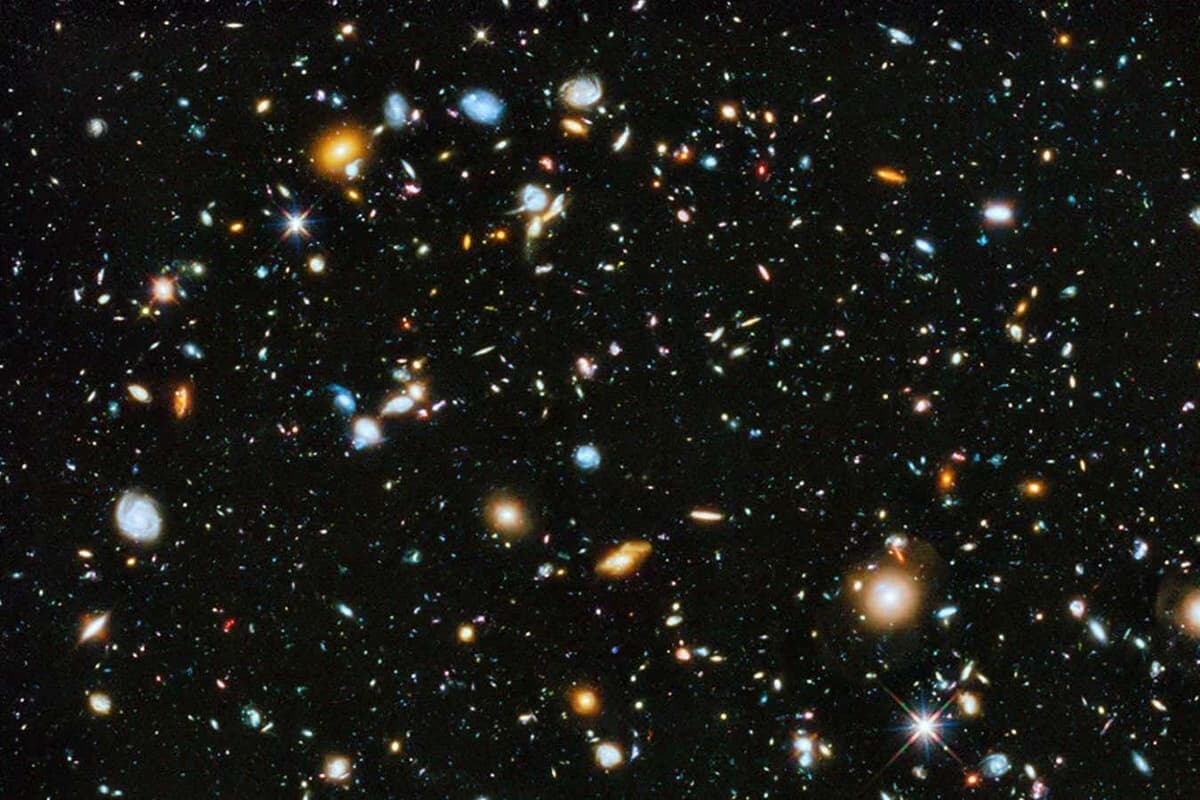
In the past year, a convergence of high‑precision measurements has begun to erode that simplicity. Deep‑field galaxy surveys, such as those from the Dark Energy Survey and the Hyper‑Suprime Cam, reveal clusters and voids that persist far beyond the scale where statistical homogeneity was expected. Simultaneously, subtle temperature variations in the cosmic microwave background—once dismissed as noise—now line up with these large‑scale structures, suggesting genuine anisotropies. Gravitational‑lensing maps from the Hubble Space Telescope and early data from the Vera C. Rubin Observatory further expose uneven mass distributions, hinting that the universe’s texture is more “lumpy” than the classic model assumes.
If the evidence holds, cosmologists will need to revise the ΛCDM framework, potentially adjusting the inferred density of dark energy or re‑examining inflationary scenarios that produce a perfectly smooth early universe. Upcoming missions like ESA’s Euclid and NASA’s Nancy Grace Roman Space Telescope are designed to chart the three‑dimensional distribution of billions of galaxies, offering the statistical power to confirm or refute the new paradigm. Beyond academia, a more complex cosmic model could influence the algorithms that power satellite navigation, deep‑space communication, and even the emerging market for space‑based data analytics, underscoring the broader economic relevance of fundamental physics breakthroughs.
100-year-old assumption about the universe may soon be overturned
Comments
Want to join the conversation?
Loading comments...