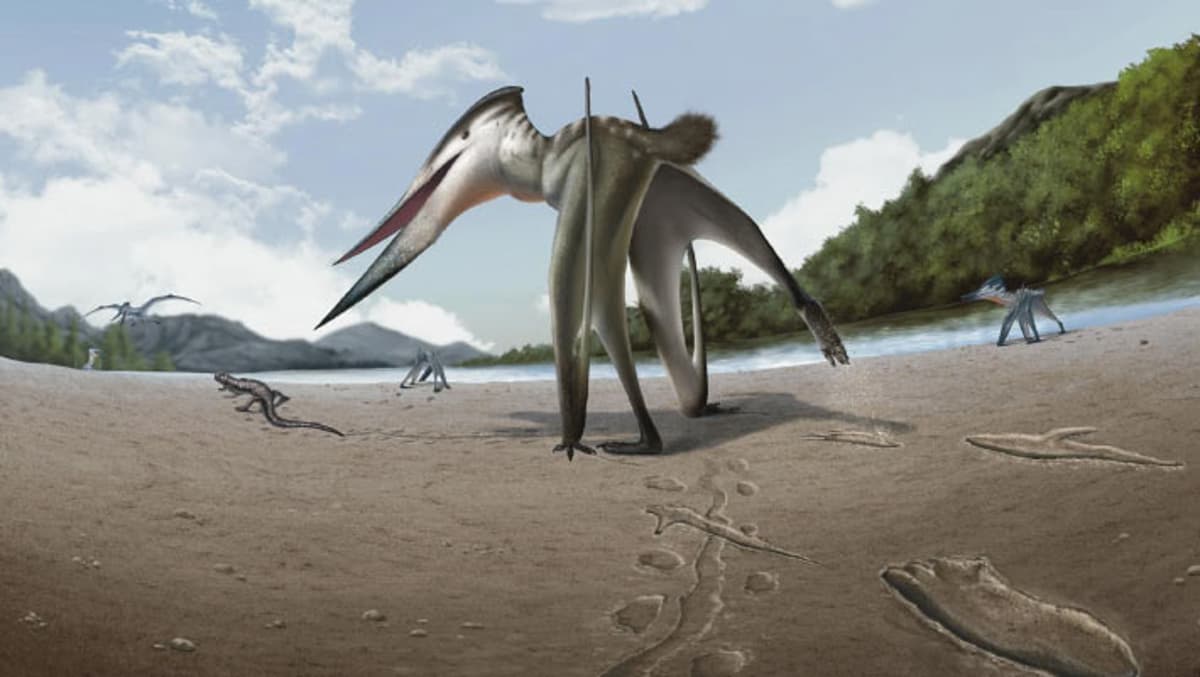
106-Million-Year-Old Pterosaur Footprints Discovered in Korea
Why It Matters
The discovery provides concrete evidence that giant pterosaurs actively hunted on land, reshaping our view of Mesozoic food webs and pterosaur ecology.
Key Takeaways
- •New ichnogenus Jinjuichnus procerus identified from 106‑million‑year‑old Korean tracks
- •Footprints suggest neoazhdarchian pterosaurs could run ~0.8 m/s on land
- •Parallel small vertebrate tracks hint at possible predator‑prey interaction
- •Findings support hypothesis of terrestrial hunting behavior in large pterosaurs
- •Study published in Scientific Reports expands understanding of Mesozoic ecosystems
Pulse Analysis
The debate over how pterosaurs used their limbs on the ground has persisted for decades, with most reconstructions emphasizing aerial prowess while downplaying terrestrial activity. Recent biomechanical studies hinted that the massive neoazhdarchians, including azhdarchids and thalassodromids, possessed sturdy limbs capable of supporting weight and generating forward thrust. However, without direct trace evidence, these hypotheses remained speculative. The Korean trackway changes that narrative by delivering a tangible snapshot of a large pterosaur walking—or possibly sprinting—along a shoreline, bridging the gap between form and function.
The Jinju Formation footprints, now assigned to the new ichnogenus Jinjuichnus procerus, display elongated, asymmetrical digits and a stride consistent with a speed of about 0.8 m sec⁻¹. Such velocity aligns with modern terrestrial stalkers like storks, suggesting that these reptiles could pursue prey on firm substrates. The co‑occurring small vertebrate trackway, likely a salamander or lizard, shows an abrupt change in direction and increased stride length, implying a sudden burst of speed that may have been triggered by the approaching pterosaur. While alternative explanations—such as coincidental crossing—cannot be ruled out, the spatial and temporal proximity of the two trackways offers the most compelling ichnological hint of predator‑prey interaction in the fossil record.
Beyond the dramatic chase scenario, the discovery has broader implications for reconstructing Mesozoic ecosystems. It confirms that neoazhdarchians occupied a niche comparable to modern wading birds, exploiting both aerial and terrestrial resources. This dual capability could explain their global distribution and persistence until the end‑Cretaceous extinction. Paleontologists now have a new benchmark for interpreting other ambiguous tracksites, and future fieldwork may focus on locating additional paired trackways to refine models of pterosaur locomotion and behavior. As more data emerge, the image of pterosaurs shifts from passive sky‑riders to versatile apex predators that shaped ancient landscapes.
106-Million-Year-Old Pterosaur Footprints Discovered in Korea
Comments
Want to join the conversation?
Loading comments...