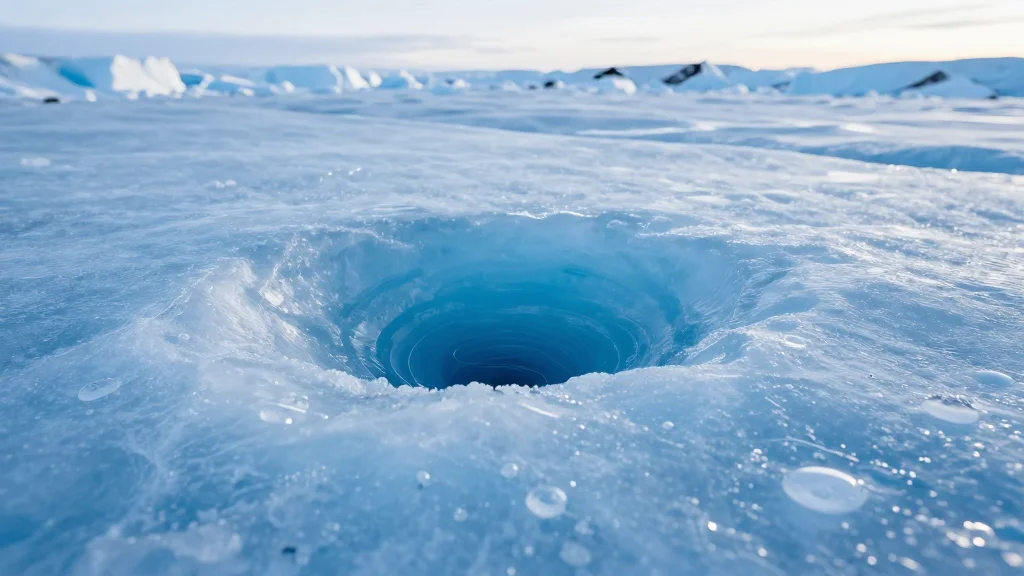
19‑Mile Asteroid Crater Discovered Beneath Greenland’s Hiawatha Glacier

Why It Matters
The Hiawatha crater demonstrates that Earth’s polar ice can conceal major geological events, challenging the assumption that ice sheets erase older surface features. By revealing a well‑preserved impact structure, the find provides a rare window into the Late Paleocene, a period of significant climatic change, and may help scientists link extraterrestrial impacts to shifts in Earth’s climate system. Beyond academic interest, the discovery has practical implications for ice‑sheet modeling. Understanding how large, rigid structures interact with flowing ice can improve predictions of glacier dynamics, which are critical for sea‑level rise forecasts. The crater also underscores the value of advanced remote‑sensing technologies in uncovering hidden aspects of Earth’s geology, potentially guiding future resource exploration and hazard assessment in remote polar regions.
Key Takeaways
- •Airborne radar identified a 19‑mile (30 km) circular crater beneath Hiawatha Glacier.
- •Meltwater sediments contain shocked quartz and iron‑rich fragments, confirming an asteroid impact.
- •Radiometric dating places the impact at ~58 million years ago, in the Late Paleocene.
- •The crater is listed among NASA’s 25 largest impact structures and is the first found under a continental ice sheet.
- •Discovery prompts new surveys of polar ice sheets for hidden geological features.
Pulse Analysis
The Hiawatha discovery arrives at a moment when remote‑sensing capabilities are reaching unprecedented resolution. Airborne radar, once limited to mapping sub‑glacial lakes, now delivers detailed topography through kilometers of ice, turning the polar regions into a new frontier for planetary geology. Historically, impact craters have been cataloged on exposed land, but the Greenland find suggests a hidden population that could revise global impact frequency estimates.
From a climate‑science perspective, the timing of the impact aligns with the Paleocene‑Eocene Thermal Maximum, a period of rapid warming that reshaped marine and terrestrial ecosystems. While causality remains speculative, the crater provides a concrete geological marker that can be integrated into climate models to test hypotheses about impact‑driven atmospheric perturbations. Moreover, the preservation of a sharp rim beneath moving ice challenges prevailing models of glacial erosion, implying that ice flow may be less destructive to rigid structures than previously thought.
Looking ahead, the Hiawatha crater could become a benchmark site for interdisciplinary research, linking impact physics, glaciology, and climate science. If subsequent radar surveys uncover additional buried craters, the scientific community may need to rethink the role of ice sheets as both protectors and archivists of Earth’s deep‑time record. The next field season’s drilling campaign will be pivotal: high‑precision dating and geochemical analysis could either cement the crater’s place in Paleocene history or reveal a more complex impact chronology, shaping the narrative of Earth’s geological and climatic evolution for years to come.
19‑Mile Asteroid Crater Discovered Beneath Greenland’s Hiawatha Glacier
Comments
Want to join the conversation?
Loading comments...