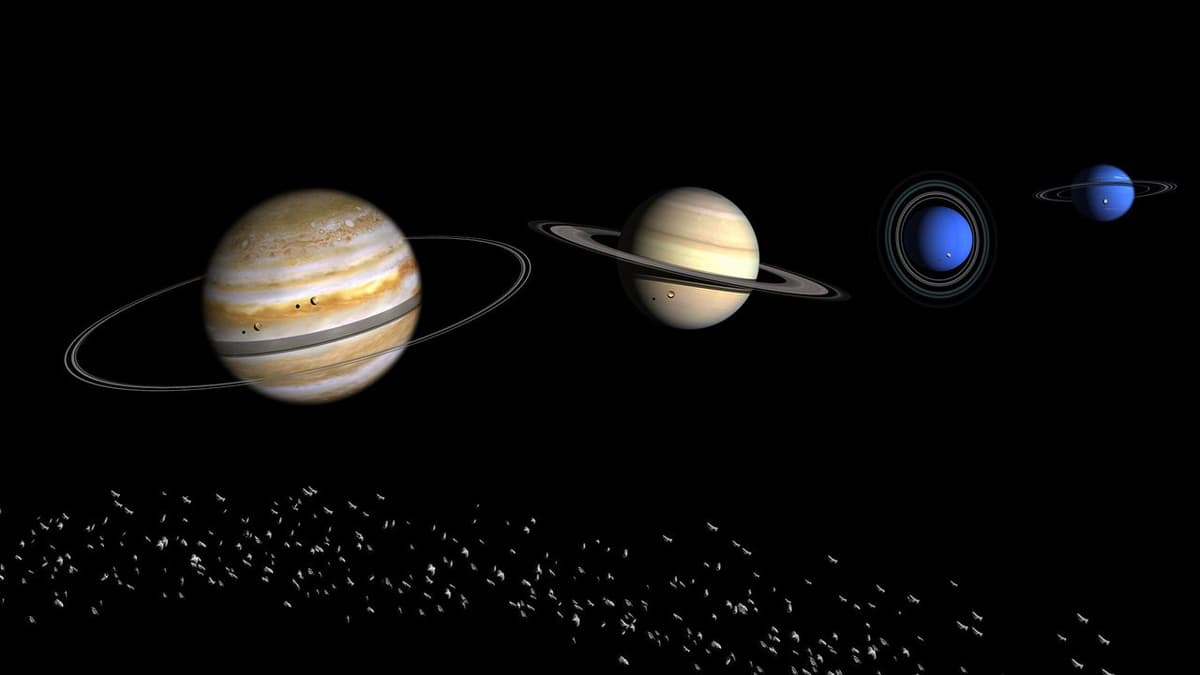
2 Giant 'Super Earths' Once Orbited Near Uranus and Neptune, Messed up a Bunch of Moons, Then Vanished, New Study Hints
Why It Matters
Understanding whether one or two missing ice giants existed reshapes theories of planetary migration and satellite survival, influencing models of exoplanet system evolution. It also offers a plausible explanation for the unusual composition of Uranus’s moon Miranda.
Key Takeaways
- •Simulations suggest two extra ice giants once orbited outer solar system
- •Jupiter’s moons stay stable only when two extra planets are present
- •Uranus’s moons remain stable with just one extra ice giant
- •Extra planets likely ejected, becoming rogue interstellar objects
- •Miranda’s high ice content may result from past moon collisions
Pulse Analysis
The latest research revisits the Nice Model, which posits that giant‑planet migration reshaped the early Solar System. By running 122 high‑resolution simulations that include satellite dynamics, scientists discovered that the presence of one or two additional ice‑giant planets dramatically alters the stability of moons around Jupiter and Uranus. This nuanced view suggests that the delicate 1:2:4 resonance of Io, Europa and Ganymede likely survived only because two extra planets were present, providing a new constraint on the timing and magnitude of the giant‑planet instability.
A key implication of the study is the potential origin story for Uranus’s odd moon Miranda. The simulations show that extra planets could have destabilized Uranus’s satellite system, causing collisions that fragmented moons and redistributed ice. The resulting debris may have re‑accreted into Miranda, explaining its unusually high ice fraction compared to other Uranian moons. This scenario bridges dynamical modeling with observable moon characteristics, offering a testable hypothesis for future observations and missions.
Beyond our own backyard, the findings inform how common such violent reshuffling might be in exoplanetary systems. If super‑Earth‑mass ice giants can be ejected during early instability phases, many distant planetary systems may harbor rogue planets drifting through interstellar space. Recognizing these processes helps astronomers interpret the architecture of observed exoplanet systems and refine predictions about satellite survivability in dynamically active environments.
2 giant 'super Earths' once orbited near Uranus and Neptune, messed up a bunch of moons, then vanished, new study hints
Comments
Want to join the conversation?
Loading comments...