Why It Matters
MUST’s massive increase in spectroscopic throughput will turn billions of imaging detections into precise distance measurements, accelerating answers to dark‑energy, neutrino‑mass and gravity questions while reshaping the global leadership in cosmology research.
Key Takeaways
- •MUST will host >20,000 robotic fibers, four times DESI’s count
- •Survey efficiency ten times higher than any current spectroscopic instrument
- •Aim to map redshifts of 100 million galaxies by early 2030s
- •6.5 m mirror and largest aspheric lens deliver sharp, wide‑field images
- •Data will tighten constraints on dark energy, neutrino mass, relativity
Pulse Analysis
Imaging surveys such as Euclid and the Vera Rubin Observatory are poised to catalog tens of billions of galaxies, yet without spectroscopic follow‑up their raw photometry cannot reveal distances, chemistry or dynamics. The Dark Energy Spectroscopic Instrument (DESI) in Arizona currently leads the field, capturing 5,000 spectra per exposure, but its capacity is dwarfed by the sheer volume of upcoming imaging data. This mismatch has spurred a race to build next‑generation multiplexed spectrographs that can turn static pictures into three‑dimensional maps of cosmic structure.
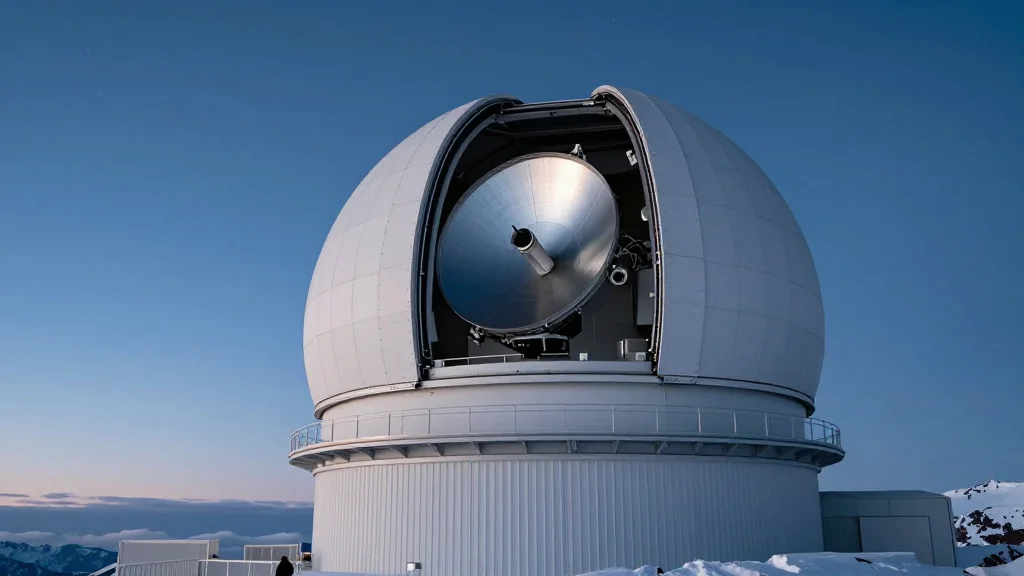
Enter the Multiplexed Survey Telescope (MUST), a Chinese‑led effort that pushes multiplexing to an unprecedented scale. Positioned at 4,380 m in Qinghai, the telescope’s 6.5 m primary mirror feeds a five‑lens wide‑field corrector topped by the world’s largest aspheric lens, guaranteeing sub‑arcsecond image quality across a field equivalent to twenty full moons. At its Cassegrain focus, more than 20,000 independently steerable fiber positioners can lock onto individual targets within seconds, allowing simultaneous spectroscopy of thousands of galaxies. This architecture translates to a ten‑fold boost in survey speed compared with DESI, enabling an eight‑year program that will secure redshifts for over 100 million galaxies and quasars.
The scientific payoff is profound. A denser, deeper three‑dimensional map will sharpen measurements of the universe’s expansion history, tightening constraints on the dark‑energy equation of state and testing whether Einstein’s general relativity holds on gigaparsec scales. The massive sample will also improve limits on the sum of neutrino masses and probe the epoch of reionization. By delivering this capability, MUST not only accelerates fundamental physics but also rebalances the global landscape of cosmology, giving China a leading role in the next generation of large‑scale structure experiments.
20,000 eyes on the universe
Comments
Want to join the conversation?
Loading comments...