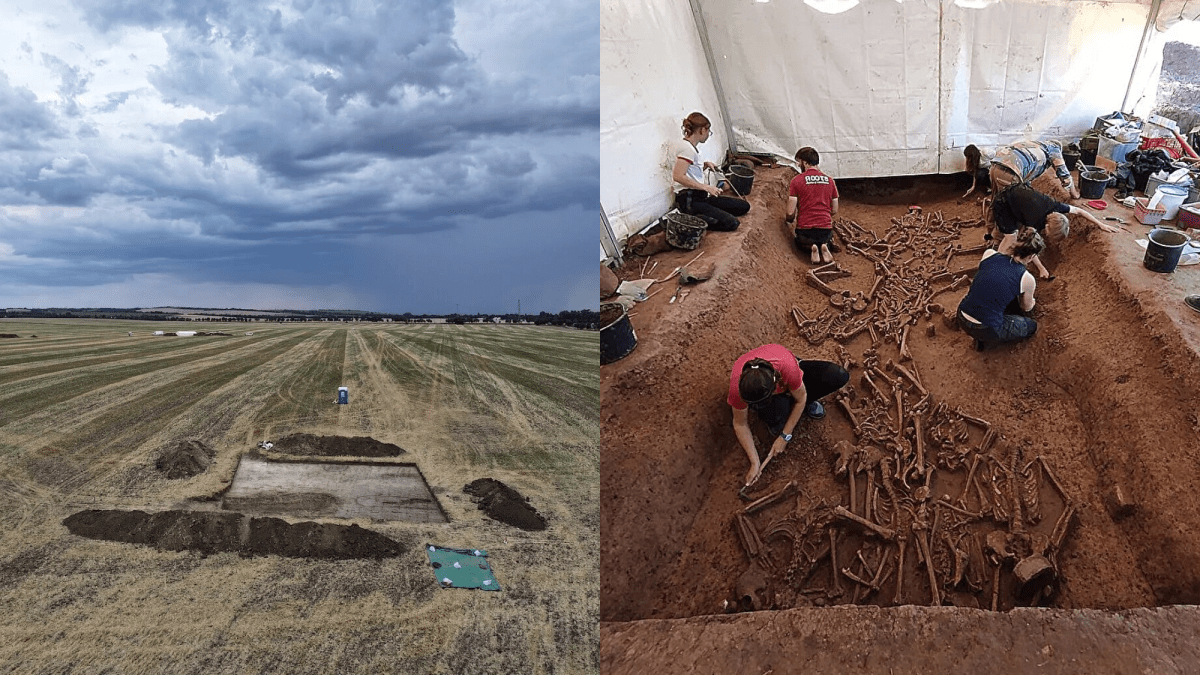
77 Headless Skeletons Found in a Field Date Back 7,000 Years
Why It Matters
The find offers rare insight into Neolithic mortuary practices and social organization, challenging assumptions about violence in early farming communities. Understanding these rituals can reshape interpretations of how prehistoric societies dealt with death and identity.
Key Takeaways
- •77 of 78 skeletons lack heads, suggesting ritual skull removal
- •Site dates to 5250‑4950 BCE, part of Linear Pottery culture
- •Skulls likely removed skillfully, not violent decapitation
- •DNA and isotope analysis will reveal diet and kinship ties
Pulse Analysis
The Vráble settlement, sprawling across three neighborhoods and encircled by a defensive ditch, is a flagship site for the Linear Pottery culture (LBK). Emerging around 5500 BCE, the LBK marks Europe’s transition from nomadic foraging to settled agriculture, making any well‑preserved burial context a goldmine for scholars. The discovery of a concentrated ditch burial, where dozens of bodies were interred in a single episode, adds a dramatic layer to our understanding of how early farmers organized space, labor and communal identity.
What sets Vráble apart is the systematic removal of skulls from 77 of the 78 individuals. Microscopic analysis of cut marks indicates precise, non‑violent excision, suggesting a ritualized practice rather than battlefield decapitation. Comparable skull‑removal customs appear in later Neolithic and Bronze Age societies, often linked to ancestor veneration or symbolic display, but the Vráble pattern is unique in its scale and lack of accompanying grave goods. This challenges the long‑standing narrative that early farming groups were primarily concerned with survival, hinting instead at complex belief systems surrounding death and the body.
Future work will leverage high‑resolution DNA sequencing, strontium isotope mapping and paleopathological assessment to reconstruct the buried population’s genetic affiliations, mobility, and health. Such data could reveal whether the individuals were local kin, outsiders, or a mixed group, shedding light on social cohesion and conflict resolution in early agrarian communities. By decoding these ancient practices, scholars can refine models of cultural transmission, ritual behavior, and the evolution of social complexity during a pivotal era of human history.
77 headless skeletons found in a field date back 7,000 years
Comments
Want to join the conversation?
Loading comments...