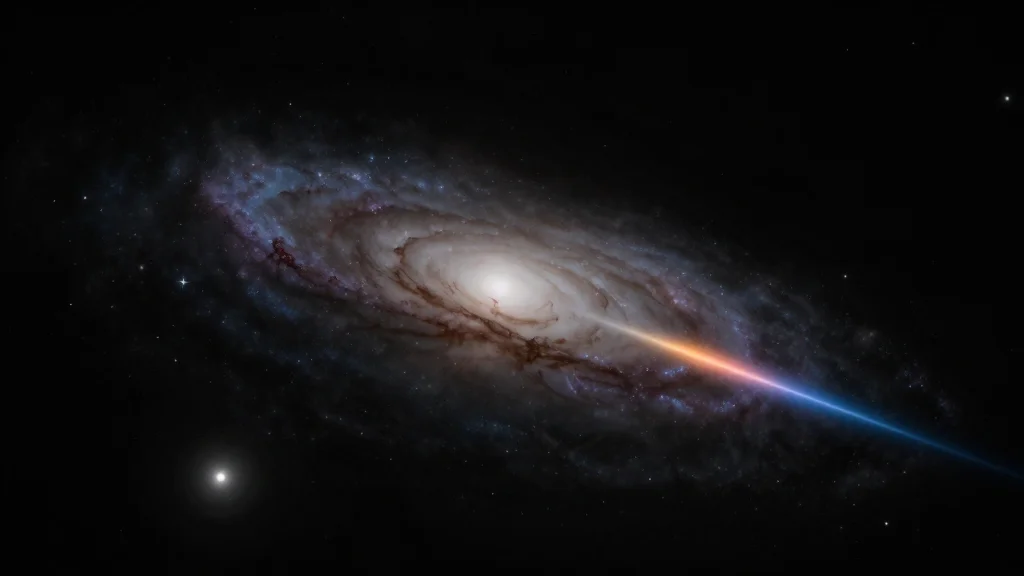
7‑Hour Gamma‑Ray Burst Sets New Record, Points to Helium‑Star Merger

Why It Matters
GRB 250702B forces a revision of the standard taxonomy of gamma‑ray bursts, suggesting that binary interactions can produce engines lasting hours rather than seconds. This has downstream effects on how scientists estimate the rate of massive‑star deaths, the production of heavy elements, and the expected signatures of related gravitational‑wave events. By exposing a blind spot in current monitoring strategies, the discovery also drives investment in next‑generation high‑energy observatories that can capture the full diversity of cosmic explosions. Beyond astrophysics, the event underscores the value of coordinated, multi‑instrument observations for capturing rare phenomena. The ability to piece together data from gamma‑ray, X‑ray, infrared and radio telescopes sets a precedent for future transient science, where rapid, cross‑band collaboration will be essential for unlocking the physics of the most extreme environments in the universe.
Key Takeaways
- •GRB 250702B lasted 7 hours (25,000 seconds), breaking the previous record of 15,000 seconds.
- •Helium‑star merger model explains the prolonged engine by a black hole feeding on a stripped helium companion.
- •Afterglow detected in X‑ray, infrared and radio bands places the burst in a dusty, star‑forming region.
- •Observational bias may have hidden similar ultra‑long bursts; multi‑instrument detection was crucial.
- •Future missions like COSI aim to improve sensitivity to faint, long‑duration high‑energy transients.
Pulse Analysis
The GRB 250702B event arrives at a moment when the high‑energy astrophysics community is grappling with the limits of its classification schemes. For decades, the binary split between short (merger‑driven) and long (collapsar‑driven) bursts has provided a convenient framework, but the seven‑hour duration of GRB 250702B forces a third category—ultra‑long bursts—into the conversation. Historically, ultra‑long bursts have been rare, partly because detection pipelines prioritize short, high‑contrast signals. The fact that GRB 250702B was only identified through a coordinated effort across several observatories suggests that the true population may be larger, hidden beneath the noise floor of existing surveys.
From a theoretical standpoint, the helium‑star merger scenario revitalizes interest in binary evolution pathways that were previously considered peripheral to gamma‑ray burst production. The angular‑momentum transfer mechanisms described in the studies echo earlier work on tidal disruption events, but on a much shorter timescale and with relativistic jets. If future observations confirm that a significant fraction of ultra‑long bursts arise from such mergers, models of massive‑star death will need to incorporate a broader suite of binary interactions, potentially linking gamma‑ray bursts to a subset of Type Ib/c supernovae and to low‑frequency gravitational‑wave sources detectable by next‑generation interferometers.
Looking ahead, the launch of COSI and upgrades to existing gamma‑ray monitors will likely increase the detection rate of faint, extended transients. This will enable statistical studies that can quantify how common helium‑star mergers are relative to traditional collapsars. Moreover, the multi‑messenger approach—combining electromagnetic afterglows with gravitational‑wave alerts—could finally close the loop on the progenitor question, delivering a holistic picture of how the most energetic explosions in the universe are powered.
7‑Hour Gamma‑Ray Burst Sets New Record, Points to Helium‑Star Merger
Comments
Want to join the conversation?
Loading comments...