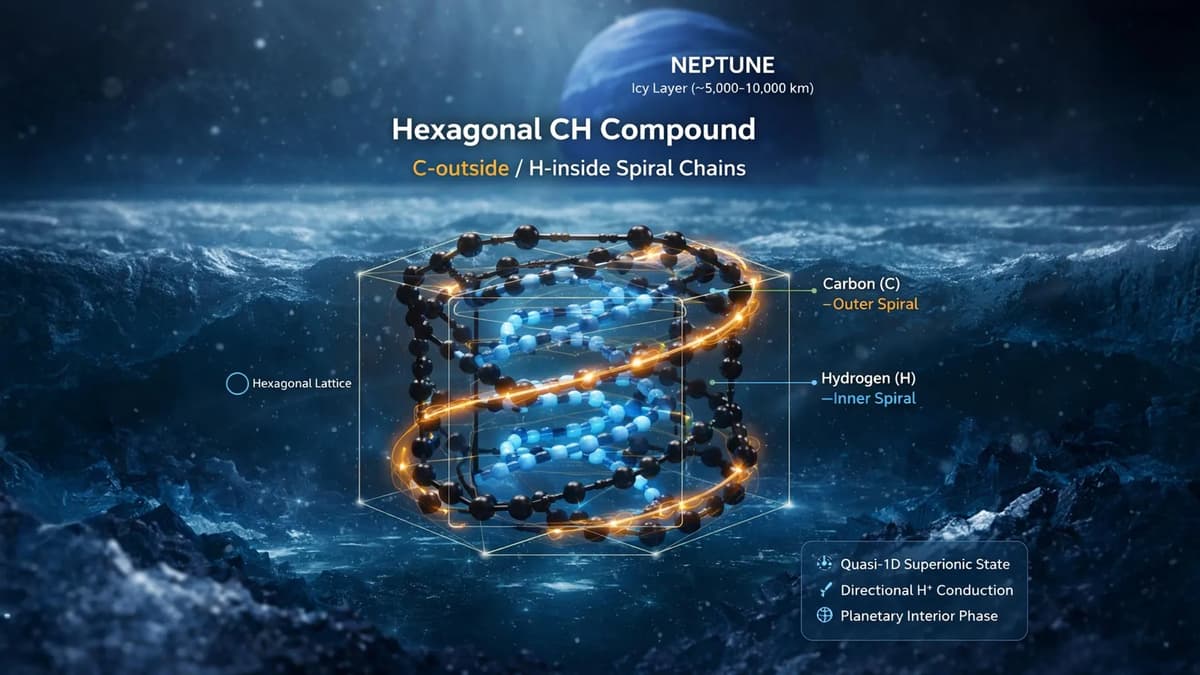
A Bizarre New State of Matter May Be Hiding Inside Uranus and Neptune
Why It Matters
Understanding this superionic carbon‑hydrogen phase helps explain the anomalous magnetic fields of ice giants and opens pathways for designing directional conductive materials on Earth.
Key Takeaways
- •Simulations predict carbon‑hydride superionic phase inside ice giants
- •Hydrogen moves helically within carbon lattice, forming quasi‑1D pathways
- •Phase could affect heat and electricity transport, influencing magnetic fields
- •Findings expand understanding of matter under millions‑of‑atm pressures
- •May inspire new directional materials for engineering applications
Pulse Analysis
The interiors of Uranus and Neptune have long puzzled scientists because their magnetic fields are tilted and offset compared with those of Earth or Jupiter. Traditional models assume "hot ice" layers composed of water, methane and ammonia, but the exact composition and physical state remain uncertain. As exoplanet surveys reveal thousands of distant worlds, refining our picture of ice‑giant interiors becomes critical for planetary formation theories and for interpreting magnetic signatures observed by space telescopes.
Liu and Cohen tackled this knowledge gap with high‑performance quantum simulations that combined machine‑learning potentials and density‑functional theory. By reproducing pressures up to 3,000 GPa and temperatures near 6,000 K, they uncovered a striking superionic arrangement: carbon atoms lock into a hexagonal lattice while hydrogen ions glide along helical channels. This quasi‑one‑dimensional motion blurs the line between solid and liquid, a hallmark of superionic materials, and suggests that charge carriers in the deep layers may travel preferentially along defined pathways rather than diffusing isotropically.
If hydrogen conducts electricity along these spirals, the resulting anisotropic transport could influence the dynamo processes that generate the planets' magnetic fields, potentially explaining their unusual geometry. Beyond planetary science, the discovery showcases how simple elements can assemble into complex, ordered structures under extreme conditions, offering a blueprint for engineered materials with directional conductivity or thermal management properties. Future laboratory experiments at megabar pressures and follow‑up observations of ice‑giant magnetospheres will test these predictions, bridging the gap between astrophysical theory and practical material innovation.
A bizarre new state of matter may be hiding inside Uranus and Neptune
Comments
Want to join the conversation?
Loading comments...