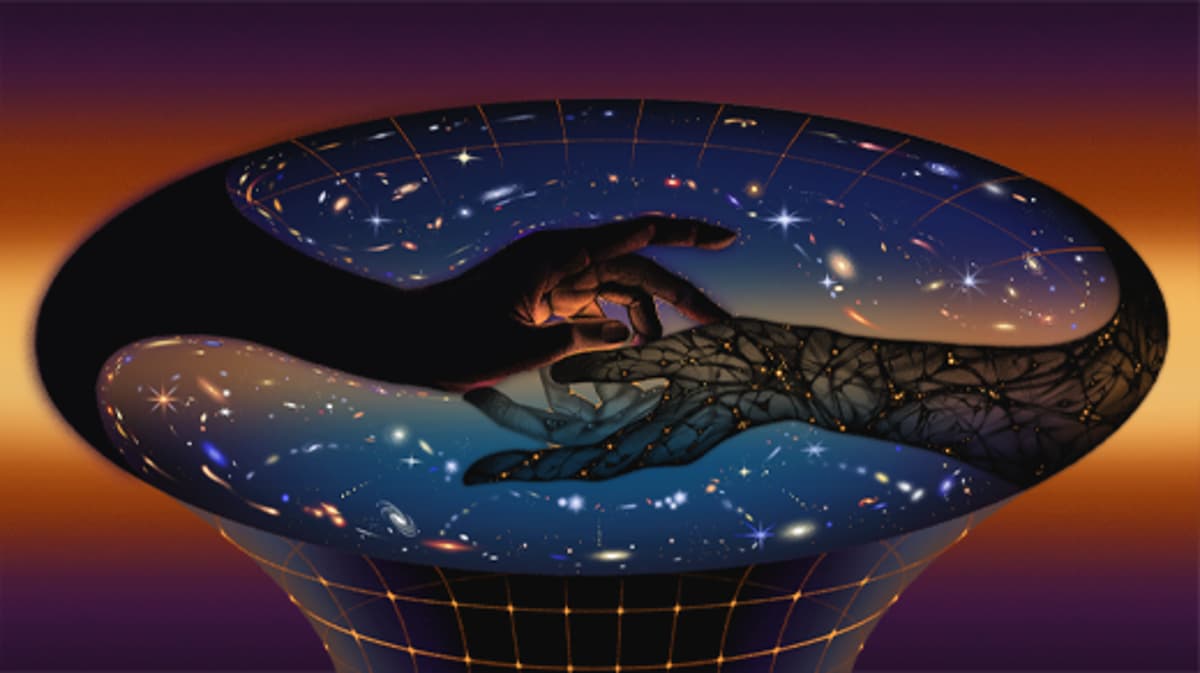
A Dark Dimension Could Link Two of the Universe’s Great Unknowns
Why It Matters
Linking dark energy and dark matter offers a testable pathway to resolve the Hubble tension and could reshape the standard cosmological model, impacting both fundamental physics and future observational strategies.
Key Takeaways
- •DESI data show dark energy density fell after 2 billion years.
- •Models propose a micron‑scale dimension linking energy and matter.
- •Interaction may resolve ~9% Hubble constant tension.
- •Predicted extra dark‑matter force stays below current limits.
- •String‑theory calculations now align with astrophysical observations.
Pulse Analysis
The latest DESI results have revived a once‑marginal idea: that dark energy is not a static vacuum energy but a dynamical component that can evolve over cosmic time. By showing a modest decline in its density after a peak two billion years ago, the data force cosmologists to revisit models where the dark sector is interactive. This shift opens a window for theories that tie dark energy to dark matter, moving beyond treating them as unrelated ghosts of the universe.
String‑theory researchers have taken this cue to flesh out a concrete mechanism—a micron‑scale “dark dimension” that hosts massive gravitons acting as dark matter. In this picture, variations in the size of the extra dimension simultaneously adjust dark energy’s pressure and dark matter’s mass, producing the phantom‑like signatures observed. Crucially, the framework predicts a subtle long‑range force among dark‑matter particles, a prediction that remains comfortably below the limits set by galaxy‑tidal‑tail searches, yet offers a tangible target for next‑generation surveys.
If the coupling hypothesis holds, it could alleviate the persistent Hubble tension by allowing the expansion rate to differ naturally between early and late epochs. This would diminish the need for ad‑hoc systematic error explanations and provide a unified narrative for two of cosmology’s biggest puzzles. As observational precision improves—through missions like the Euclid satellite and the Vera C. Rubin Observatory—these models will face stringent tests, potentially ushering in a new era where string‑inspired physics moves from abstract mathematics to empirical science.
A Dark Dimension Could Link Two of the Universe’s Great Unknowns
Comments
Want to join the conversation?
Loading comments...