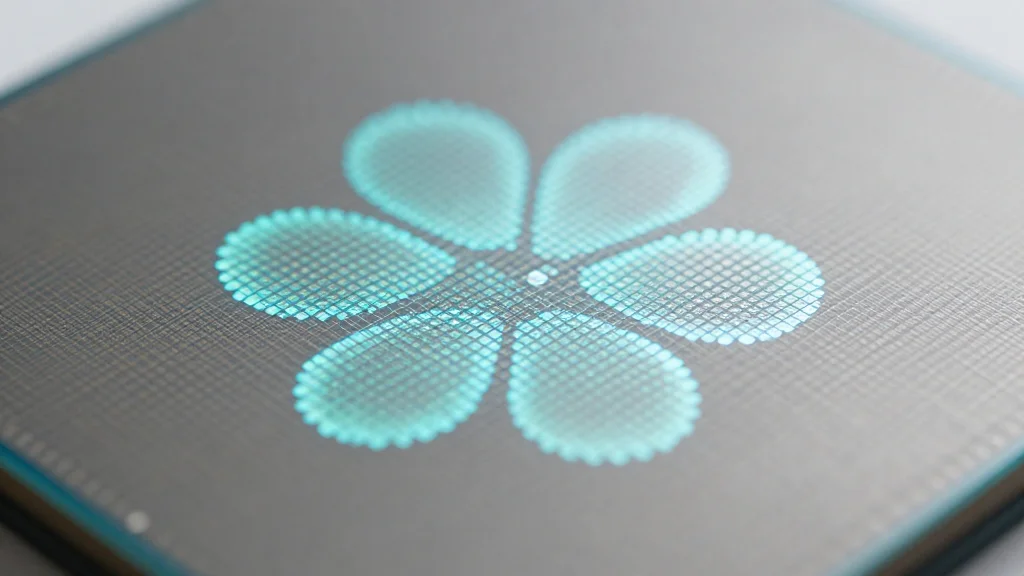
A Flower-Like Pattern Exposes Chiral Superconductivity's Long-Sought Fingerprint
Why It Matters
Chiral superconductors are topological, offering robust qubits for quantum computers, and this direct observation accelerates material engineering toward scalable quantum technologies.
Key Takeaways
- •Tin‑silicon monolayer shows clear chiral superconductivity fingerprint.
- •Flower‑like quasiparticle interference pattern reveals atomic‑scale hole at defect.
- •Triangular lattice of tin atoms enables chirality absent in square lattices.
- •QPI imaging provides a design‑by‑experiment route to unconventional superconductors.
- •Findings pave way for topological qubits and AI‑driven pattern recognition.
Pulse Analysis
The discovery of a flower‑shaped quasiparticle interference (QPI) pattern marks a pivotal moment in the hunt for chiral superconductors, a class of materials where electron pairs acquire a handedness that endows them with topological protection. Traditional superconductors, such as the high‑temperature cuprates, lack this property because their square lattice symmetry suppresses chirality. By engineering a triangular lattice of tin atoms on a silicon substrate, researchers created a clean platform where the symmetry constraints are lifted, allowing the elusive chiral order to emerge and be directly visualized.
Scanning tunneling microscopy enabled the team to capture interference waves emanating from single‑atom defects, producing a striking flower‑like motif with a dark central spot—an unmistakable signature of chiral pairing. The pattern aligns precisely with advanced theoretical models, confirming that the observed phenomenon is not a coincidental artifact but a fundamental property of the material. This level of control and verification represents a shift from serendipitous discovery to intentional design in condensed‑matter physics, offering a reproducible pathway to explore other unconventional superconducting phases.
Beyond the immediate scientific triumph, the implications for quantum technology are profound. Chiral superconductors are inherently topological, meaning their quantum states are resistant to local disturbances—a critical requirement for stable qubits. The researchers are already leveraging artificial‑intelligence tools to catalog QPI images, aiming to automate the identification of similar fingerprints in future material candidates. As the field moves toward scalable quantum devices, the ability to engineer and recognize chiral superconductivity could accelerate the development of fault‑tolerant quantum processors.
A flower-like pattern exposes chiral superconductivity's long-sought fingerprint
Comments
Want to join the conversation?
Loading comments...