Why It Matters
Understanding galaxy mergers informs models of star formation, gravitational dynamics, and the evolution of large‑scale cosmic structures, which are critical for both academic research and commercial space‑technology applications.
Key Takeaways
- •Antenna Galaxies illustrate star formation triggered by galactic collisions
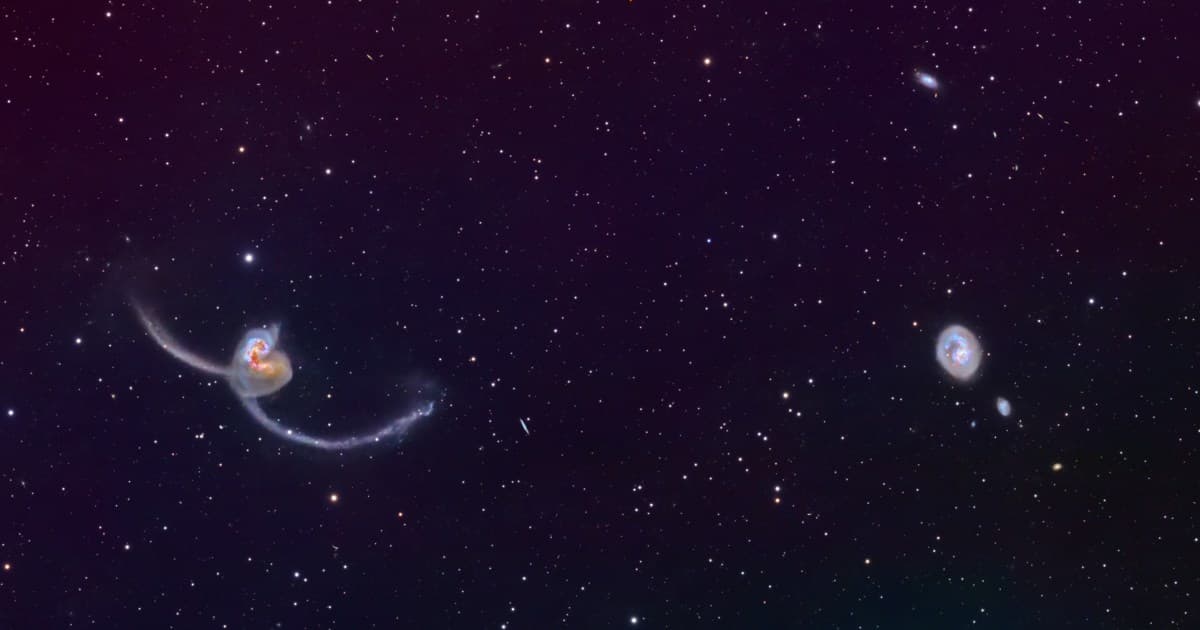
- •20‑hour exposure reveals detailed Hα emission in tidal tails
- •Amateur astronomer Greg Meyer used a 5‑inch telescope for deep‑sky imaging
- •Images aid researchers modeling gravitational dynamics of merging galaxies
- •Public interest in such visuals fuels demand for advanced astrophotography equipment
Pulse Analysis
The Antenna Galaxies (NGC 4038/4039) in Corvus are a textbook case of two spiral galaxies in the throes of a merger. As their mutual gravity stretches stellar disks, long tidal tails of gas and young stars arc outward, creating a dramatic “antenna” shape that has become iconic in both scientific literature and popular media. Astronomers study this system to understand how collisions ignite bursts of star formation, redistribute angular momentum, and eventually give rise to elliptical galaxies. The visible chaos offers a real‑time laboratory for testing models of galactic evolution.
The latest image, captured by amateur astrophotographer Greg Meyer, pushes the limits of what a modest 5‑inch telescope can achieve. Over 20 hours and 50 minutes of exposure through Hα + LRGB filters, the frame isolates ionized hydrogen regions, highlighting active star‑forming knots along the tails. Such deep‑sky work demonstrates the growing power of consumer‑grade optics, high‑sensitivity sensors, and sophisticated stacking software, driving demand for next‑generation astrophotography gear. The result is a market where hobbyists contribute data that complement professional observatories.
Beyond aesthetic appeal, high‑resolution views of interacting galaxies feed directly into computational simulations used by aerospace firms and research institutions. Accurate tidal‑force maps improve predictions of gravitational wave sources and inform navigation strategies for future deep‑space missions that may encounter dense stellar environments. Moreover, public fascination with cosmic collisions fuels educational outreach and supports funding for large‑scale telescopes. As the line blurs between amateur and professional contributions, the Antenna Galaxies continue to shape both scientific inquiry and the commercial ecosystem surrounding space imaging technology.
A galactic collision
Comments
Want to join the conversation?
Loading comments...