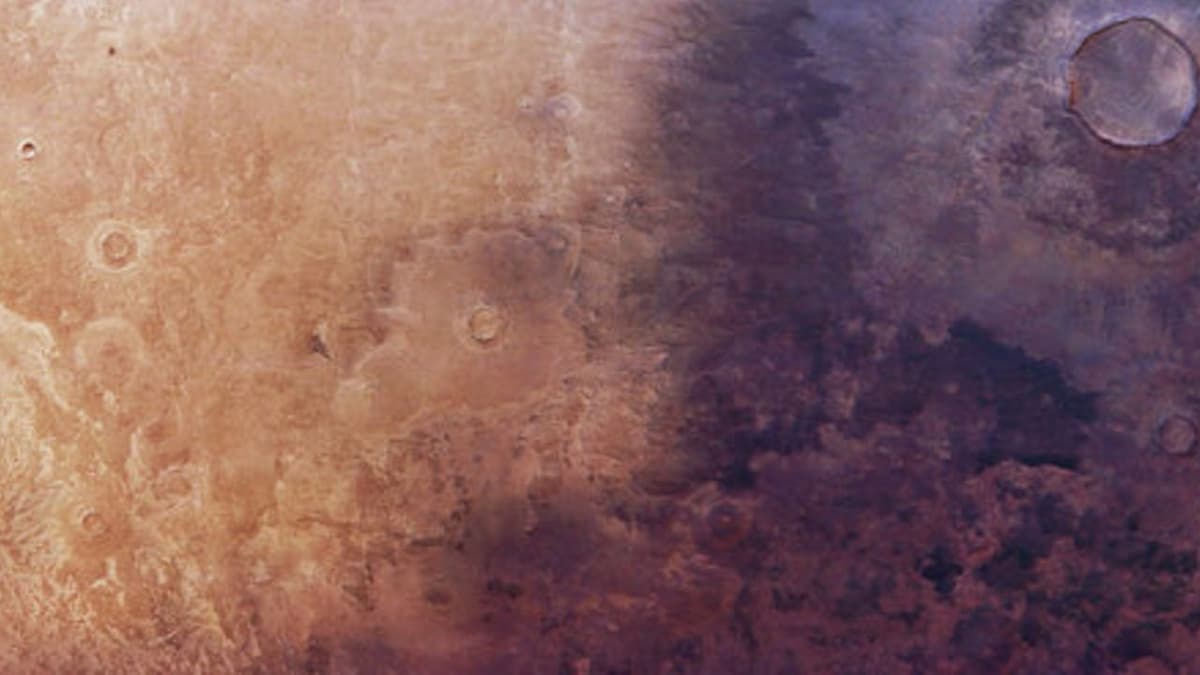
A Giant 'Shadow' Has Been Creeping Across Mars for 50 Years — and Scientists Aren't Sure Why
Why It Matters
The ongoing expansion demonstrates that Mars is not entirely geologically inert, reshaping our models of its climate and surface dynamics and influencing future exploration strategies.
Key Takeaways
- •Dark ash patch in Utopia Planitia expanding ~6.5 km annually
- •Expansion observed over 50 years via ESA Mars Express imagery
- •Scientists cite wind‑driven dust redistribution, but cause remains uncertain
- •Region holds ancient ocean signs, grabens, and buried ice
- •Suggests Mars may still experience active surface processes
Pulse Analysis
The discovery of a moving dark patch on Mars challenges the long‑standing view of the Red Planet as a dead world. First noted by Viking 2 in 1976, the ash‑laden terrain in Utopia Planitia has now been tracked across half a century of orbital imagery. Its measured advance of about 6.5 km each year indicates that surface processes are still active, driven by forces that can mobilize fine volcanic material over vast distances. This gradual shift, captured by ESA’s Mars Express, adds a dynamic layer to our understanding of Martian geology, suggesting that wind and perhaps seasonal temperature swings continue to sculpt the landscape.
Researchers propose two primary explanations: high‑velocity Martian winds lifting and redepositing ash, or the erosion of a lighter ochre dust veneer that previously masked the darker substrate. Both scenarios point to a more vigorous atmospheric system than previously modeled, especially in the planet’s northern plains where dust storms can envelop the entire globe. The phenomenon also aligns with recent findings from China’s Zhurong rover, which identified ancient shoreline features and a climatic shift 400,000 years ago, hinting at a complex interplay between surface deposits and atmospheric evolution.
For mission planners, the expanding patch carries practical implications. The presence of volatile‑rich ash and underlying ice could become valuable resources for future human outposts, while the active redistribution of material may affect landing site safety and rover navigation. Continuous monitoring will be essential to refine climate models, assess habitability potential, and guide the selection of scientific targets as humanity prepares for the next wave of Mars exploration.
A giant 'shadow' has been creeping across Mars for 50 years — and scientists aren't sure why
Comments
Want to join the conversation?
Loading comments...