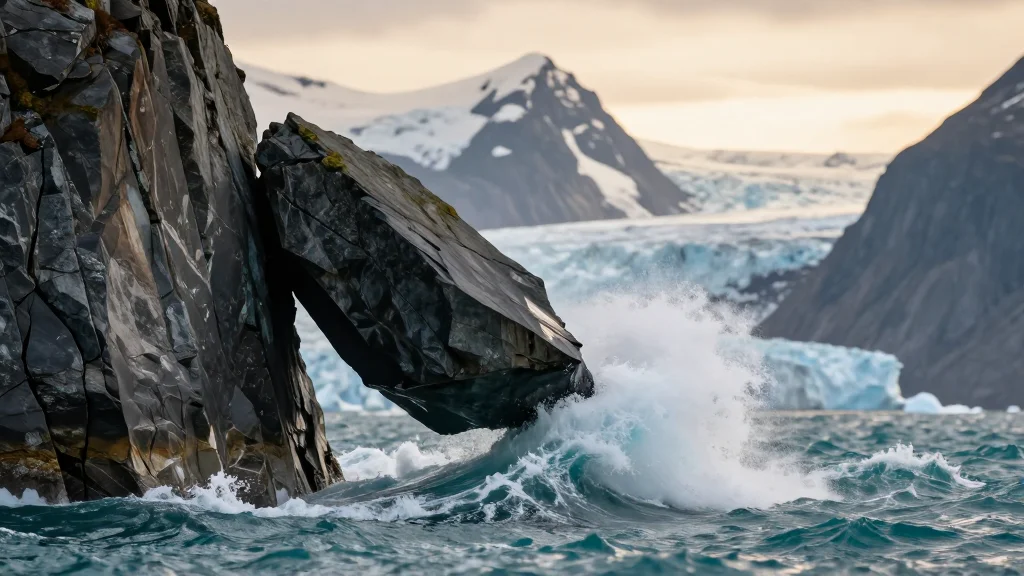
A Landslide in Alaska Set Off a Tsunami. There May Be More to Come.
Why It Matters
Increasing glacier melt and permafrost thaw amplify the likelihood of massive landslides that can spawn tsunamis, threatening coastal communities and infrastructure far beyond Alaska.
Key Takeaways
- •2025 Tracy Arm landslide displaced volume 24× Great Pyramid of Giza
- •Wave reached 1,578 feet (480 m) high, triggering second‑largest tsunami
- •Rapid South Sawyer Glacier retreat exposed unstable rock, sparking collapse
- •Models predict 36‑hour seiche oscillations, highlighting complex post‑event dynamics
- •Scientists warn climate‑driven landslides could raise global tsunami risk
Pulse Analysis
The Tracy Arm disaster illustrates a growing class of geohazards where climate‑induced glacier retreat destabilizes steep rock faces. As permafrost thaws, the once‑frozen matrix that binds slopes weakens, allowing massive blocks to detach and plunge into water bodies. This mechanism, now documented in Alaska, is being observed across fjord‑lined coasts from Norway to Chile, suggesting a systemic shift in coastal risk profiles linked to rising global temperatures.
Predicting such events remains a scientific frontier. While high‑resolution LiDAR and satellite imagery can map terrain, the precise timing of a slope failure depends on subtle thermal and hydrological cues that are difficult to capture in real time. The Science paper’s computer models successfully recreated the 2025 slide and its 36‑hour seiche, yet the authors caution that early‑warning systems lack the granularity to issue alerts before a collapse occurs. Advances in machine‑learning‑driven hazard modeling and continuous ground‑temperature monitoring could narrow this gap, but substantial investment and interdisciplinary collaboration are required.
For policymakers and insurers, the implications are immediate. Coastal towns that have never faced tsunami threats may need to reassess building codes, evacuation routes, and insurance premiums. Moreover, the potential for cascading impacts—such as sediment plumes affecting fisheries and shipping lanes—adds layers of economic vulnerability. Integrating glacier‑monitoring data into regional emergency‑management frameworks will be essential to mitigate the emerging risk of landslide‑generated tsunamis worldwide.
A Landslide in Alaska Set Off a Tsunami. There May Be More to Come.
Comments
Want to join the conversation?
Loading comments...