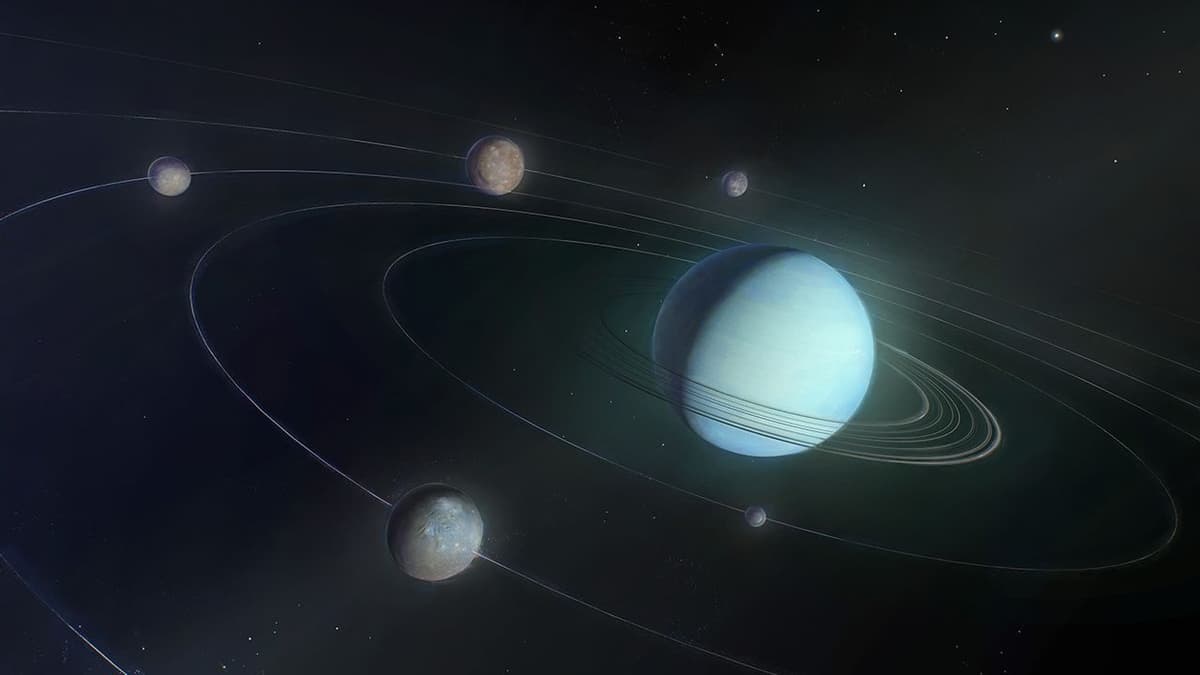
A 'Lost Planet' May Have Given Jupiter and Uranus Their Moons
Companies Mentioned

Why It Matters
Understanding a hidden ice giant reshapes models of planetary migration and explains why our giant planets retain stable moon systems, a key factor in assessing habitability and system stability elsewhere.
Key Takeaways
- •Jupiter’s moons survived in just 15% of simulated early‑solar‑system histories
- •Uranus’s moons survived in only about 9% of simulations
- •Both moons survived together in roughly 1% of scenarios
- •Only scenarios with an extra ice giant kept both moon systems intact
- •Ejected ice giant likely escaped at ~7 million km distance from Jupiter
Pulse Analysis
The early solar system was far more crowded than the eight‑planet arrangement we see today. Astronomers have long used the Nice model to explain how the giant planets shifted outward, but recent work by Matthew Clement and colleagues adds a crucial twist: a fifth ice giant that was flung into interstellar space within the first billion years. By tweaking the number and mass of giant planets in 122 simulation runs, the team showed that this rogue world’s gravitational nudges were essential for preserving the delicate orbital resonances of Jupiter’s Galilean moons and the satellite families of Uranus.
Survival odds for the moons were startlingly low. In the suite of models, Jupiter’s moons remained intact in only about 15% of cases, while Uranus’s moons survived roughly 9% of the time. The overlap—both moon systems intact—occurred in just 1% of runs, and every successful overlap required the presence of an extra ice giant. The simulations indicate that a close encounter, bringing Jupiter within 4.3 million miles (7 million km) of the wandering planet, provided just enough dynamical disturbance to prevent catastrophic collisions without ejecting the moons themselves.
If a lost ice giant once roamed our backyard, the implication reaches beyond our own system. It suggests that planetary systems may commonly experience early instability phases that prune their architecture, leaving behind the stable configurations we observe. Future telescopic surveys of exoplanetary systems could look for signatures of such past ejections—high‑eccentricity debris belts or orphaned planetary-mass objects. The study thus not only refines our narrative of solar‑system formation but also offers a template for interpreting the chaotic histories of distant worlds.
A 'lost planet' may have given Jupiter and Uranus their moons
Comments
Want to join the conversation?
Loading comments...