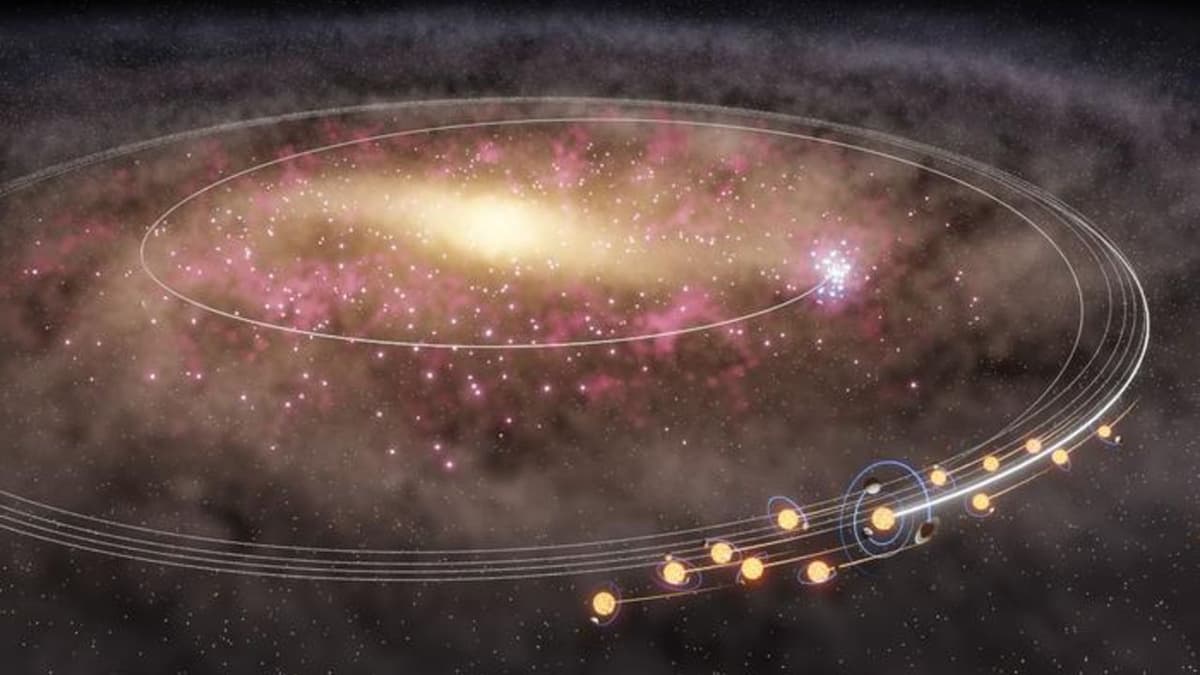
A 'Mass Migration' Of Stars From the Milky Way's Center Could Explain Why There's Life in Our Solar System
•March 12, 2026
0
Why It Matters
The discovery ties the Sun’s habitability to a galaxy‑scale event, reshaping models of planetary system evolution and the timing of Milky Way bar formation.
Key Takeaways
- •Gaia identified 6,594 solar twins, 30× previous count
- •Majority of twins located near Sun, indicating shared migration
- •Milky Way central bar formed 4‑6 billion years ago
- •Bar formation likely drove outward migration of Sun and twins
- •Migration moved Sun to quieter outer disk, aiding habitability
Pulse Analysis
The European Space Agency’s Gaia mission, now retired after a decade of precision astrometry, has delivered an unprecedented census of Sun‑like stars. By cataloguing 6,594 stellar twins—objects matching the Sun in age, temperature, composition and surface gravity—astronomers have a statistically robust sample to trace the Sun’s birthplace. This trove of data, far exceeding earlier surveys, reveals that many of these twins share a common orbital history, hinting at a coordinated migration event that reshaped the inner Milky Way.
Astrophysicists attribute this large‑scale movement to the emergence of the Milky Way’s central bar, a dense, elongated structure of stars and gas that formed roughly 4 to 6 billion years ago. The bar’s gravitational torques not only sparked a burst of star formation but also acted as a stellar conveyor belt, flinging stars outward from the galactic core. The Sun, born about 4.5 billion years ago, appears to have been caught in this wave, relocating to the galaxy’s calmer outer disk long before life took hold on Earth. This scenario provides a new chronometer for dating bar formation and refines models of radial mixing in spiral galaxies.
The implications extend beyond galactic dynamics to planetary habitability. The inner Milky Way endures frequent supernovae and intense radiation, conditions hostile to emerging biospheres. By moving outward early in its history, the Sun may have avoided these hazards, offering a stable environment for Earth’s long‑term evolution. Understanding this migration pathway informs the search for life elsewhere, suggesting that planets orbiting stars that migrated from dense galactic regions could be prime targets for future biosignature investigations.
A 'mass migration' of stars from the Milky Way's center could explain why there's life in our solar system
0
Comments
Want to join the conversation?
Loading comments...