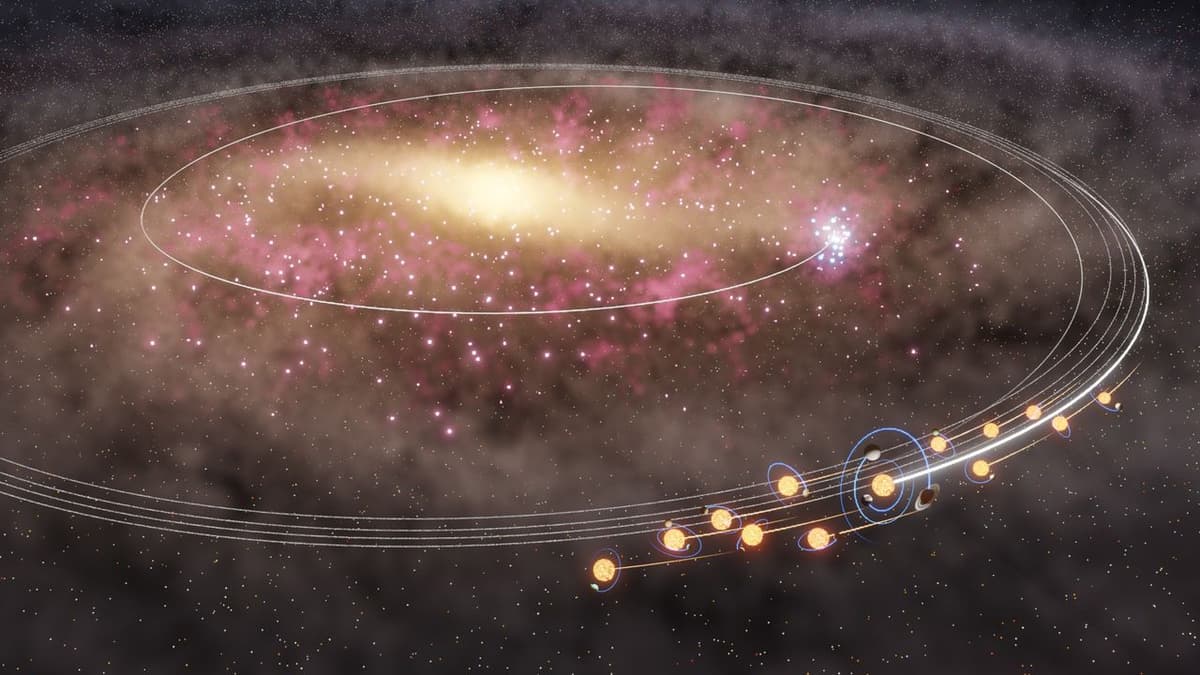
A Mass Stellar Migration Billions of Years Ago May Have Helped Life Get Started on Earth
•March 12, 2026
0
Why It Matters
The outward migration explains why the Sun resides in a relatively calm galactic zone, enhancing conditions for planetary habitability and informing models of galactic dynamics.
Key Takeaways
- •Sun and 1,500 twins migrated outward 4‑6 billion years ago
- •Gaia data enabled 30× larger solar twin sample
- •Migration likely linked to Milky Way bar formation
- •Outer disk offers calmer environment for planetary habitability
- •Future Gaia releases will refine Sun’s birth location
Pulse Analysis
The Gaia mission’s unprecedented 3‑dimensional map of the Milky Way has unlocked a new era of stellar archaeology. By cataloguing nearly seven thousand solar twins—stars virtually identical to our Sun—researchers could trace a collective age distribution that peaks at four to six billion years. This cohort’s shared age and similar galactocentric distance imply a coordinated outward drift, likely triggered by the nascent galactic bar that reshaped the inner disk’s gravitational landscape. The bar’s formation funneled gas inward, igniting starbursts before flinging mature stars toward the galaxy’s periphery.
Understanding this migration reshapes our picture of Milky Way evolution. The central bar, a massive rotating structure, not only governs orbital resonances but also acts as a stellar conveyor belt, redistributing angular momentum. When the bar emerged, it appears to have shepherded a wave of Sun‑like stars outward, creating a population now observed in the solar neighborhood. This insight refines models of radial mixing, chemical enrichment, and the timeline of structural features that have long been inferred from indirect evidence.
The broader significance lies in planetary habitability. Inner‑galaxy regions endure frequent supernovae and intense radiation, conditions hostile to complex life. By moving into the calmer outer disk early in its history, the Sun may have avoided these hazards, granting Earth a stable environment for life to emerge. Ongoing Gaia data releases will sharpen age and composition estimates, potentially identifying true solar twins born alongside our star and further elucidating the interplay between galactic dynamics and the emergence of life on habitable worlds.
A mass stellar migration billions of years ago may have helped life get started on Earth
0
Comments
Want to join the conversation?
Loading comments...