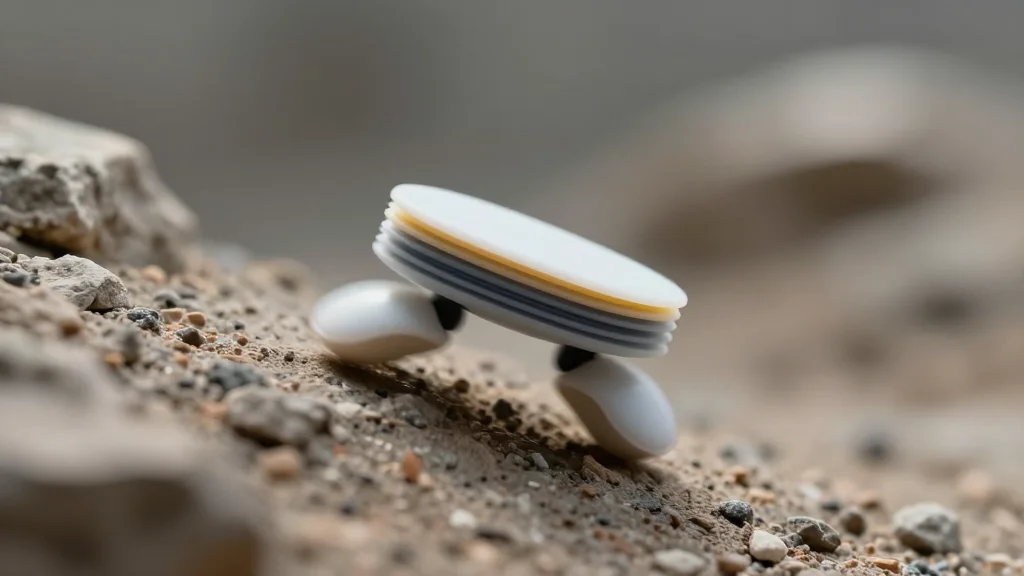
A Multimodal Variable‐speed Microrobot With Asymmetric Multilayer Structure for Moving Agility and Adaptability
Why It Matters
The breakthrough shows that microrobots can dynamically alter gait and speed using simple frequency control, expanding their utility in complex, real‑world micro‑environments and accelerating path toward practical applications.
Key Takeaways
- •Asymmetric multilayer design enables mode switching via frequency changes
- •Achieves 20.6 and 43.2 body lengths per second
- •Maintains locomotion stability across wide temperature range
- •Carries loads faster and climbs variable‑gradient slopes
- •Traverses rugged, wrinkled terrains without structural reconfiguration
Pulse Analysis
The field of soft microrobotics has long grappled with the trade‑off between design simplicity and functional versatility. While conventional microrobots excel at a single gait, real‑world environments—ranging from vascular networks to micro‑fabricated assemblies—demand rapid transitions between locomotion modes and speeds. Piezoelectric actuation offers high frequency response, yet integrating multimodal movement without adding complex control hardware remains elusive. The newly reported microrobot addresses this gap by leveraging an asymmetric multilayer architecture that modulates resonance characteristics, thereby delivering animal‑like agility in a miniature platform.
At the heart of the device is a stack of passive layers arranged asymmetrically around a central piezoelectric film. This geometry creates distinct resonance peaks, each triggering a different deformation pattern and consequently a separate gait. In laboratory tests the robot sprinted at 20.6 body lengths per second in a crawling mode and doubled that speed to 43.2 body lengths per second when operating in a jumping‑like mode. Moreover, performance proved insensitive to temperature swings from 0 °C to 80 °C and survived repeated compressive loads, underscoring its robustness.
The ability to switch gaits on‑the‑fly opens pathways for microrobotic tasks that were previously impractical. Medical scenarios such as targeted drug delivery could benefit from a robot that climbs vessel walls, accelerates under load, and escapes occlusions without external re‑programming. Industrial inspection of micro‑channels or hazardous waste sites may likewise exploit the robot’s capacity to navigate steep gradients and irregular surfaces. By eliminating the need for additional actuators or re‑fabrication, the asymmetric multilayer approach promises lower production costs and faster deployment, accelerating the commercialization of soft microrobots.
A Multimodal Variable‐speed Microrobot With Asymmetric Multilayer Structure for Moving Agility and Adaptability
Comments
Want to join the conversation?
Loading comments...