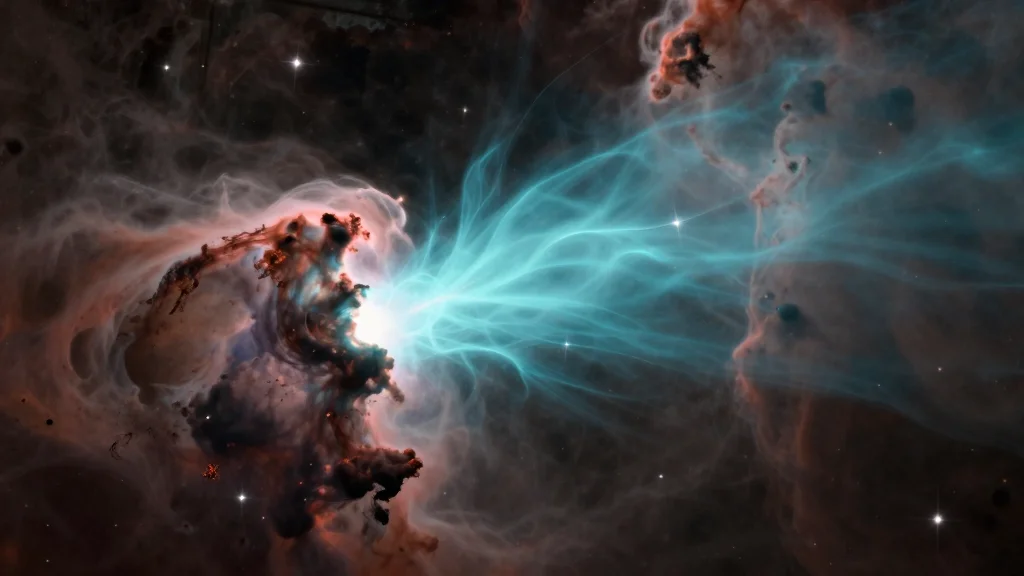
A Natural Chemistry Laboratory in Protostar Shock Waves
Why It Matters
By revealing how shocks can form and preserve complex organics, the findings refine models of chemical evolution from star‑forming clouds to planetary systems, deepening our grasp of the origins of prebiotic molecules.
Key Takeaways
- •First detection of acetonitrile, acetaldehyde, deuterated methanol in IRAS 4B1 outflow
- •Shock fronts act as natural labs, driving formation of complex organics
- •Findings suggest pre‑stellar ices survive shocks, preserving early chemical signatures
- •COM distribution maps reveal temperature‑dependent formation pathways within protostellar jets
- •Results expand limited sample beyond L1157‑B1, enabling broader shock chemistry studies
Pulse Analysis
Astrochemistry seeks the pathways that turn simple interstellar atoms into the complex organics that seed planetary systems. Shock waves generated by protostellar jets concentrate energy and density, creating fleeting environments where high temperatures break apart existing molecules while simultaneously forging new bonds. This natural laboratory mirrors early Earth conditions, making it a focal point for researchers aiming to trace the origins of prebiotic chemistry across the galaxy.
The recent PRODIGE observation with the Northern Extended Millimeter Array targeted the Class 0 source IRAS 4B1, revealing acetonitrile, acetaldehyde and deuterated methanol within its outflow. These detections are significant because nitrogen‑bearing COMs like acetonitrile are rare, while deuterated methanol’s survival indicates that ice‑mantle material from the pre‑stellar phase can be liberated intact by shocks. Spatial mapping showed each molecule peaking at different temperature regimes, suggesting multiple, concurrent formation routes that depend on local physical conditions.
Beyond expanding the catalog of chemically rich outflows, the findings have broader implications for planet‑forming disks. If shock‑driven chemistry can seed disks with complex organics early on, nascent planets may inherit a richer chemical inventory than previously assumed. Future high‑resolution campaigns with facilities such as JWST and ALMA will test this hypothesis by probing similar jets in diverse star‑forming regions, ultimately refining models that connect interstellar chemistry to the building blocks of life.
A natural chemistry laboratory in protostar shock waves
Comments
Want to join the conversation?
Loading comments...