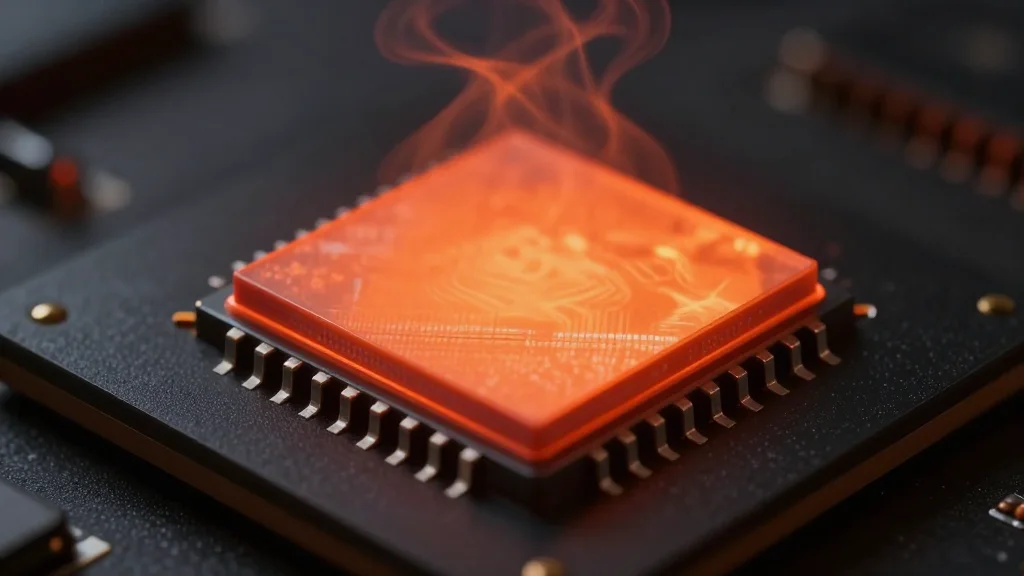
A New Memory Chip Survives 700°C and Could Enable AI in Space
Companies Mentioned
Why It Matters
By surviving temperatures far beyond conventional limits, the chip could enable on‑board AI processing where cooling is impossible, reducing latency and bandwidth costs for space and high‑temperature industrial applications.
Key Takeaways
- •Memristor operates reliably at 700 °C, far beyond typical 200 °C limit
- •Graphene layer prevents tungsten filament formation, enabling high‑temp stability
- •Device retains data over 50 hours, endures >1 billion cycles, nanosecond switching
- •Supports AI inference on spacecraft, geothermal, and nuclear systems
- •Materials align with current semiconductor fabs, easing scale‑up
Pulse Analysis
Heat has long been a hard limit for electronics, with most chips failing above roughly 200 °C. The USC team’s 700 °C‑tolerant memristor shatters that ceiling, leveraging a layered stack of tungsten, hafnium oxide and a single‑atom graphene sheet. Graphene’s weak interaction with tungsten atoms stops the formation of conductive filaments that normally short‑circuit devices at high temperature. This materials‑by‑design approach not only preserves the device’s switching behavior but also maintains low‑voltage operation and nanosecond‑scale speed, delivering a robust memory element for hostile environments.
Beyond mere data storage, memristors are prized for in‑memory computing, where they execute matrix‑multiplication directly on the chip, dramatically cutting the data movement that drains energy in AI workloads. The USC prototype demonstrated over a billion reliable switching cycles and data retention exceeding 50 hours without refresh, proving it can sustain the intensive compute cycles typical of machine‑learning inference. By integrating such high‑temperature memory with emerging logic, designers could build AI accelerators that function where conventional silicon would melt, unlocking real‑time processing on satellites, deep‑well sensors, and even fusion reactors.
The strategic implications are significant. Nvidia’s Vera Rubin Space‑1 module already aims to bring AI to orbit, but cooling in vacuum remains a bottleneck. A 700 °C‑capable memristor sidesteps that issue, enabling hardware that thrives in the radiative thermal regime of space. Likewise, geothermal and nuclear sectors could embed intelligent monitoring directly at the source, improving safety and efficiency. While the current chips are lab‑scale, the use of industry‑standard tungsten and hafnium oxide, combined with advancing wafer‑scale graphene production, suggests a feasible path to commercial manufacturing, potentially reshaping the market for rugged AI hardware.
A New Memory Chip Survives 700°C and Could Enable AI in Space
Comments
Want to join the conversation?
Loading comments...