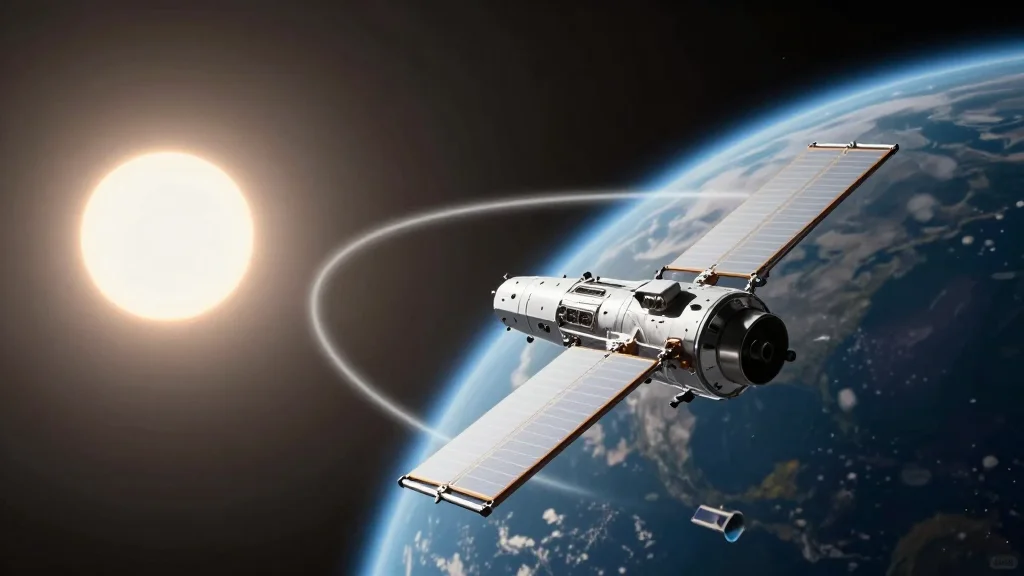
A New Way to Plan Trajectories to Asteroids
Why It Matters
By slashing propellant requirements and mission‑design costs, the new model makes commercial and scientific asteroid exploration more economically viable and reduces re‑entry risk, accelerating the path toward in‑space resource utilization.
Key Takeaways
- •New hybrid CR3BP‑two‑body model reduces computation time dramatically
- •Over 2 million low‑energy round‑trip trajectories generated for 80 NEOs
- •Algorithm finds lower launch‑escape energy than NASA’s NHATS trajectories
- •Enables use of solar electric propulsion with continuous low thrust
- •Lagrange‑point “highways” allow near‑fuel‑free transfers and safer re‑entry
Pulse Analysis
Near‑Earth objects (NEOs) have become prime targets for both scientific study and commercial resource extraction, yet plotting efficient spacecraft routes to these bodies remains a computational bottleneck. Traditional NASA planning relies on the patched‑conics technique, which simplifies the solar system to a Sun‑spacecraft two‑body problem and assumes short, high‑thrust burns. While historically sufficient, this method often overlooks subtle gravitational assists and is ill‑suited for modern low‑thrust engines, leading to over‑engineered trajectories and higher launch costs.
The new hybrid framework introduced by Beolchi et al. bridges that gap by applying the Circular Restricted Three‑Body Problem (CR3BP) in the Earth‑Sun vicinity, capturing the dynamic interplay of Lagrange points and their invariant manifolds—natural pathways that require minimal propellant. Once the spacecraft exits this region, the model reverts to the simpler two‑body dynamics, stitching together inbound and outbound legs with a continuous‑thrust profile tailored for solar electric propulsion (SEP). This dual‑regime strategy not only slashes the number of calculations needed but also uncovers low‑energy corridors that conventional methods miss, as demonstrated by the generation of more than two million viable round‑trip routes across 80 real asteroids.
The implications for the space industry are profound. Lower launch‑escape energy translates directly into reduced fuel mass, shrinking launch‑vehicle size and cost—key factors for emerging asteroid mining ventures and government science missions alike. Moreover, the slower return trajectories afford safer atmospheric re‑entry, easing thermal‑shield requirements and enhancing crew or payload survivability. As SEP and other high‑specific‑impulse propulsion systems mature, this trajectory‑optimization paradigm positions operators to exploit NEOs with unprecedented efficiency, potentially accelerating the commercialization of space resources and expanding humanity’s foothold beyond Earth.
A new way to plan trajectories to asteroids
Comments
Want to join the conversation?
Loading comments...