Companies Mentioned
Why It Matters
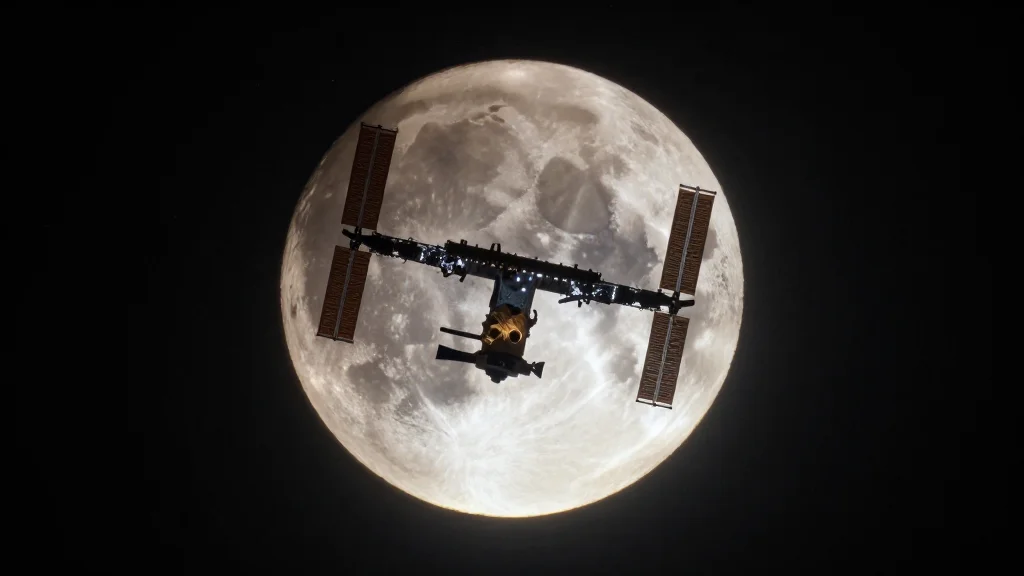
The shot shows how commercial tools enable precise tracking of high‑value space assets, boosting public interest and supporting the emerging commercial space‑imaging market.
Key Takeaways
- •Tiangong crossed Moon during Sep 2025 lunar eclipse
- •Yang used OEM data converted to TLE via Planit Pro
- •HDR blend preserved detail in Moon’s umbra
- •Offset aim kept silhouette on brighter lunar region
- •22‑frame, 0.72‑second sequence captured with Sony a1
Pulse Analysis
Lunar eclipses have long offered a dramatic backdrop for showcasing human-made objects in orbit, from the International Space Station’s 2015 Moon transit to today’s Tiangong silhouette. The September 2025 eclipse, while unfavorable for Western observers, provided an optimal geometry for Asian sky‑watchers, allowing the Chinese "heavenly palace" to glide across the Moon’s dimmed disc. This rare alignment not only creates striking visual content but also highlights the expanding presence of China’s modular space station in low‑Earth orbit, signaling its growing role in international space activities.
The technical choreography behind Yang’s capture began with the China Manned Space Agency’s orbital ephemeris, released in OEM format. By feeding this data into the mobile Planit Pro app, he generated a two‑line element set that mapped Tiangong’s trajectory across the eclipsed Moon. Selecting a site outside Chifeng, Inner Mongolia, he deliberately offset the viewing line to intersect the brighter lunar limb, ensuring a clear silhouette. Using a Sony a1 equipped with a 600 mm lens, a 2× teleconverter, and HDR stacking, he preserved detail in both the bright and dark lunar regions, compressing 22 frames into a 0.72‑second sequence that captures motion imperceptible to the naked eye.
Beyond its aesthetic appeal, the image illustrates how affordable consumer tools empower amateurs to document high‑value space assets, feeding a burgeoning market for space‑related visual media. Public exposure to Tiangong’s transit reinforces China’s narrative of a mature, independent space program and may spur interest in commercial partnerships for satellite tracking and imaging services. As more nations launch orbital platforms, the demand for precise, real‑time visual documentation will grow, positioning skilled astrophotographers and tech‑savvy enthusiasts at the forefront of a new commercial frontier.
A palace on the Moon
Comments
Want to join the conversation?
Loading comments...