A Powerful New ‘QR Code’ Untangles Math’s Knottiest Knots
Why It Matters
A fast, highly discriminating invariant reshapes knot classification, enabling breakthroughs in topology, materials science, and molecular biology where knot complexity matters.
Key Takeaways
- •New two-variable polynomial distinguishes 97% of 18‑crossing knots
- •Computation runs quickly even for knots with hundreds of crossings
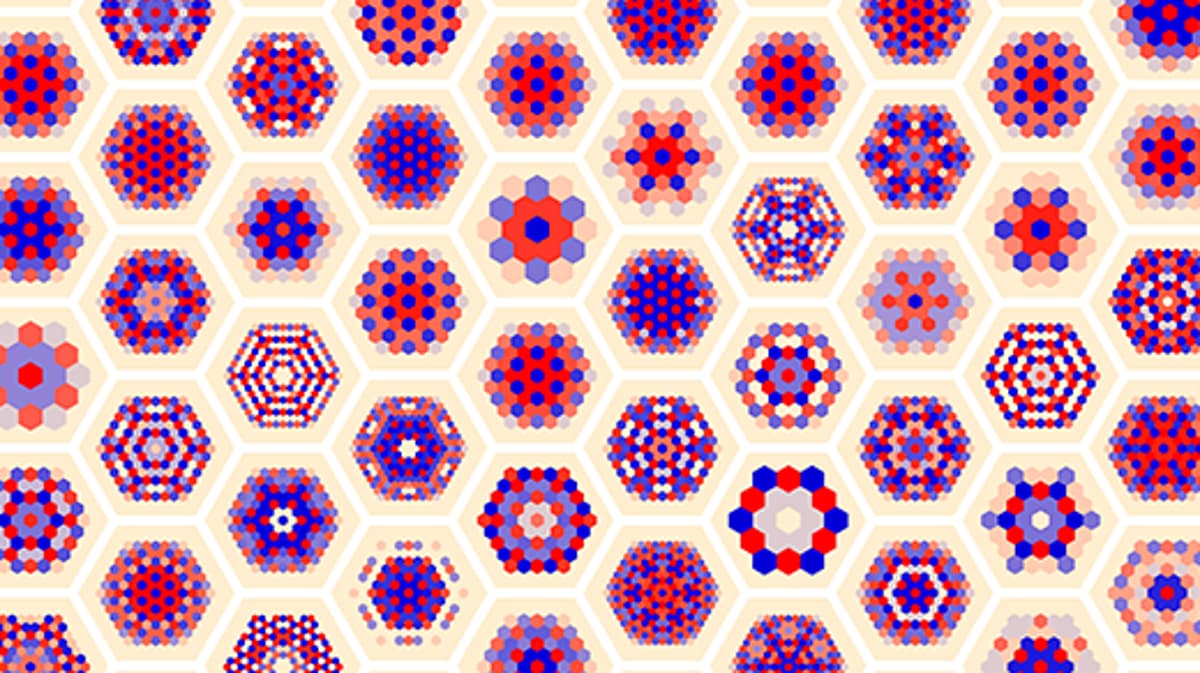
- •Visual “QR code” heat map uniquely identifies each knot
- •Hexagon diameter may give lower bound on knot genus
- •Invariant likely equals Kontsevich integral’s two‑loop polynomial
Pulse Analysis
Knot theory has long wrestled with a trade‑off: the strongest invariants, like the Kontsevich integral, are mathematically rich but computationally prohibitive, while easy‑to‑compute invariants such as three‑colorability offer little discriminatory power. This tension limits researchers’ ability to catalog increasingly complex knots that appear in DNA supercoiling, polymer entanglement, and fluid dynamics. By reframing a knot as a one‑way highway populated with probabilistic “cars,” Bar‑Natan and van der Veen forged a bridge between deep topological theory and algorithmic efficiency, producing a polynomial in variables x and y that survives the Reidemeister moves governing knot equivalence.
The resulting polynomial translates into a vivid hexagonal heat map—effectively a QR code—where each pattern uniquely tags a knot. Benchmarks show the invariant correctly separates over 97% of knots with 18 crossings, dwarfing the 42% success rate of the Jones polynomial and the 11% of the Alexander polynomial. Moreover, the calculation scales linearly, handling knots with several hundred crossings in seconds on standard hardware. This performance leap opens the door to exhaustive databases of high‑crossing knots, a resource previously out of reach for both pure mathematicians and applied scientists.
Beyond classification, the QR‑code representation hints at deeper geometric insights. The authors conjecture that the hexagon’s diameter correlates with a knot’s genus, offering a fast lower‑bound estimate for a property traditionally requiring intensive surface‑construction algorithms. If validated, this could accelerate research in fields where knot genus influences physical properties, such as the stability of knotted proteins or the elasticity of polymer networks. Future extensions—adding more car types or variables—may capture higher‑order terms of the Kontsevich integral, further tightening the link between visual invariants and the underlying topology.
A Powerful New ‘QR Code’ Untangles Math’s Knottiest Knots
Comments
Want to join the conversation?
Loading comments...