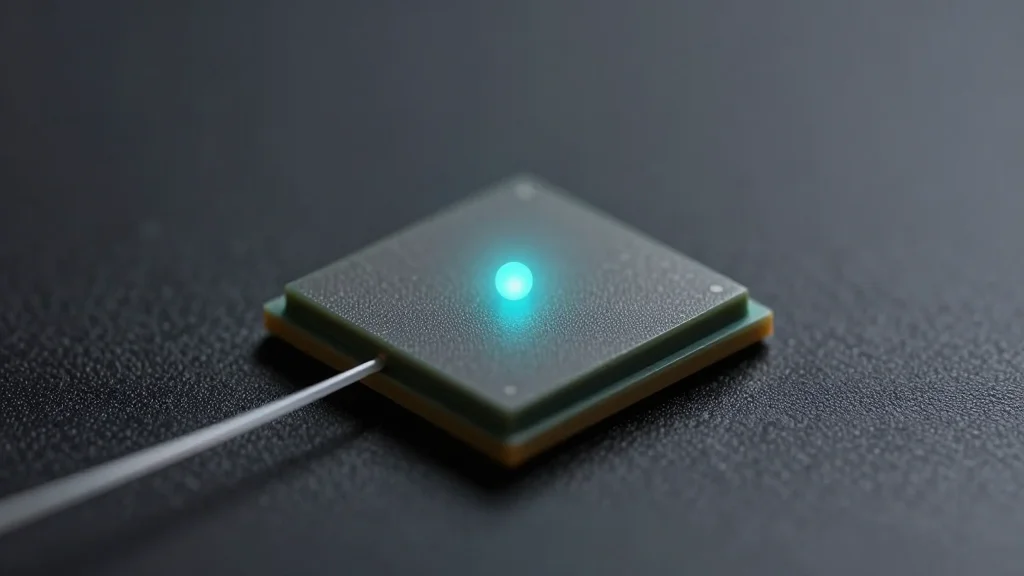
A Quantum-Coherent Photon–Emitter Interface in the Original Telecom Band
Why It Matters
By delivering high‑quality photons in the low‑loss telecom band, the technology bridges the gap between quantum hardware and existing fiber infrastructure, accelerating deployment of quantum communication and networking services.
Key Takeaways
- •Demonstrated coherent photon–emitter coupling at 1310 nm O‑band.
- •Achieved over 90% photon indistinguishability without resonant excitation.
- •Integrated quantum dot with waveguide yields >70% β‑factor.
- •Operates at cryogenic temperatures compatible with existing telecom fiber.
- •Enables deterministic quantum repeaters for scalable fiber‑based networks.
Pulse Analysis
The telecom O‑band around 1310 nm has long been the backbone of long‑distance fiber communications because of its minimal attenuation and mature component ecosystem. Quantum information protocols, however, have struggled to produce indistinguishable single photons at these wavelengths, with most laboratory demonstrations confined to the visible or C‑band (1550 nm). Prior attempts using quantum dots, rare‑earth ions, or nonlinear conversion faced trade‑offs between brightness, coherence, and integration, limiting their suitability for scalable quantum networks.
The new study overcomes these hurdles by embedding a self‑assembled InAs quantum dot into a GaAs‑on‑insulator photonic crystal waveguide engineered for O‑band operation. Using resonant pulsed excitation, the authors report transform‑limited emission linewidths and photon indistinguishability exceeding 90 %, while the waveguide design delivers a β‑factor above 70 %, indicating that most spontaneous emission is funneled into the guided mode. The interface maintains coherence at temperatures below 4 K, and the fabrication process is compatible with wafer‑scale lithography, suggesting a path toward mass‑produced quantum photonic chips.
These performance figures bring deterministic spin‑photon interfaces within reach of existing fiber infrastructure, a prerequisite for all‑photonic quantum repeaters and fault‑tolerant photonic processors. Telecom‑band compatibility reduces the need for costly wavelength conversion, lowering system complexity and power consumption for future quantum key distribution and distributed quantum computing services. Industry players developing quantum‑secure communication links can now envision integrating such sources directly into data‑center interconnects or metropolitan networks, accelerating the commercialization timeline for quantum‑enhanced security and computing.
A quantum-coherent photon–emitter interface in the original telecom band
Comments
Want to join the conversation?
Loading comments...