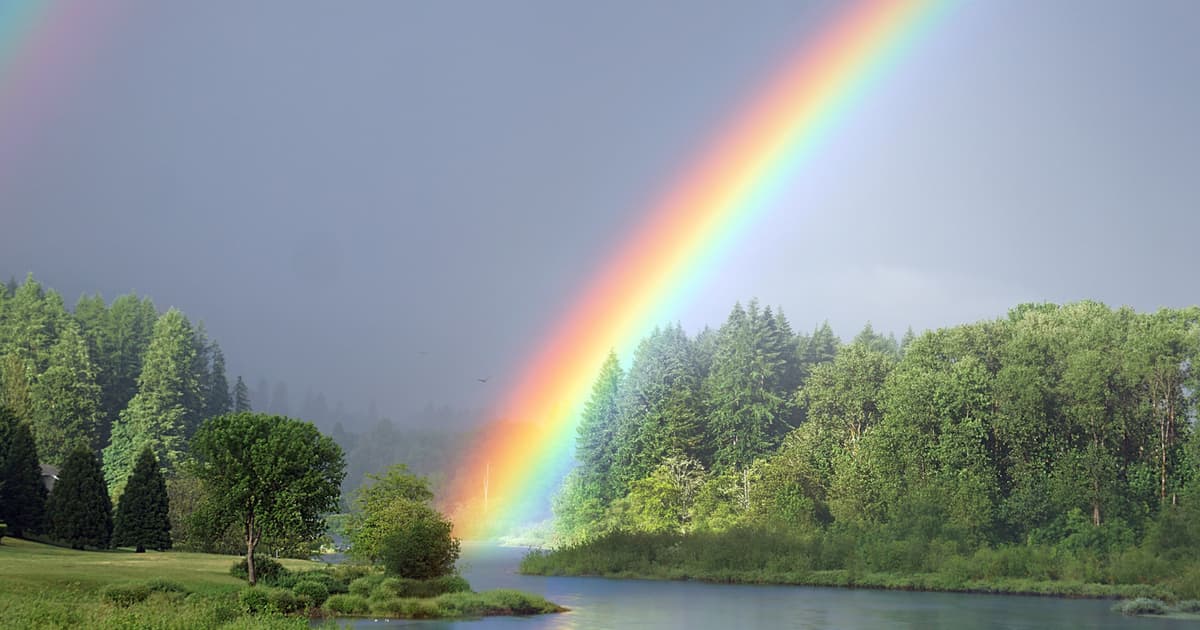
A Rainbow Is Not Actually Located in Any Specific Place in the Sky — Every Person Watching the Same Rainbow Is Seeing a Slightly Different One, Formed by Different Raindrops, and if Two People Stood Next to Each Other Looking at the Same Rainbow, the Rainbows They Are Seeing Would Be Technically Different, with No Two Viewers in the World Ever Sharing the Exact Same Rainbow
Why It Matters
Understanding that rainbows are personal optical events clarifies fundamental concepts in atmospheric optics and perception, improving science education and informing visual technologies that rely on light scattering.
Key Takeaways
- •Rainbow forms on a 42-degree cone around each observer’s antisolar point.
- •Each eye sees a slightly different rainbow due to 6 cm separation.
- •Moving changes contributing raindrops, making the rainbow appear to retreat.
- •Secondary rainbow appears at ~51 degrees after double internal reflection.
- •No two observers share identical photons; each rainbow is unique.
Pulse Analysis
Rainbows have fascinated humanity for centuries, yet their true nature is purely geometric. When sunlight enters a spherical water droplet it refracts, reflects once, and refracts again, emerging at a deviation of roughly 138 degrees. This creates a cone of light that, for any given observer, lies 42 degrees from the antisolar point—the imaginary spot directly opposite the Sun. Because the cone is anchored to the observer’s eye, the specific droplets that contribute to the visible arc differ for each person, making every rainbow a private optical experience.
The personal nature of rainbows offers a vivid teaching tool for optics and perception. Educators can demonstrate how wavelength‑dependent refraction separates white light into its constituent colors, while also illustrating how the brain fuses slightly disparate images from each eye into a single perception. Atmospheric scientists use similar scattering principles to interpret satellite imagery and lidar data, where viewing geometry determines the returned signal. Photographers, too, benefit from understanding the 42‑degree angle to position themselves for optimal rainbow capture, knowing that a slight shift in location changes the contributing droplets and the arc’s apparent position.
Beyond the classroom, the concept that no two observers share the same rainbow underscores broader lessons about subjectivity in visual data. In fields such as autonomous vehicle sensing or virtual‑reality rendering, recognizing that sensor placement alters the light paths captured can improve algorithmic accuracy. Moreover, the metaphor of a uniquely personal rainbow resonates in cultural narratives, reminding us that even shared natural wonders are experienced individually. Ongoing research continues to refine the mathematical models of light‑droplet interactions, promising ever‑more precise simulations for climate modeling and artistic visualization.
A rainbow is not actually located in any specific place in the sky — every person watching the same rainbow is seeing a slightly different one, formed by different raindrops, and if two people stood next to each other looking at the same rainbow, the rainbows they are seeing would be technically different, with no two viewers in the world ever sharing the exact same rainbow
Comments
Want to join the conversation?
Loading comments...