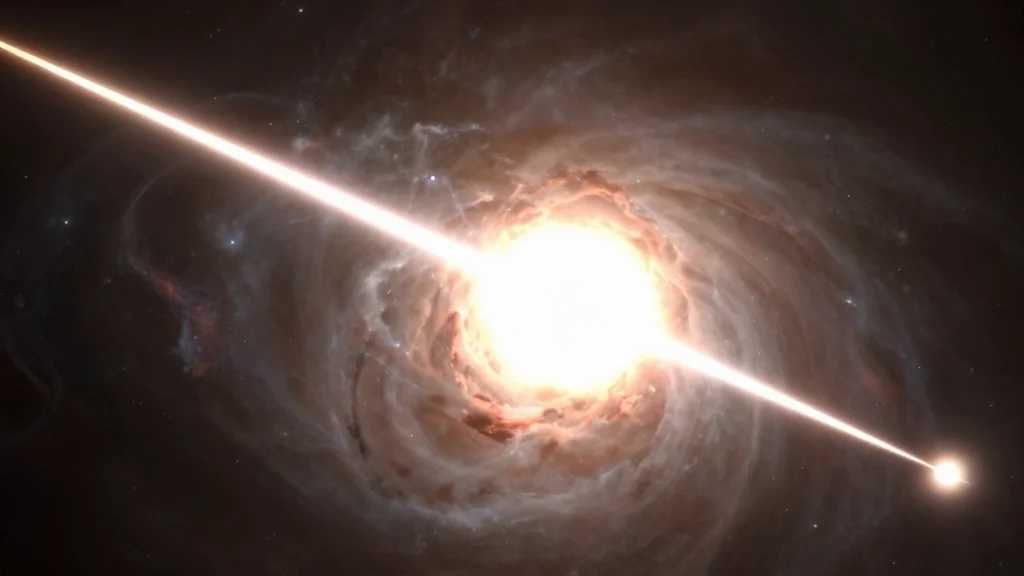
A Star's Death Throes Involves a Lot of Kicking
Why It Matters
Understanding the kick mechanisms of supernova remnants improves predictions for neutron‑star populations and gravitational‑wave event rates, influencing both astrophysics research and future space‑mission planning.
Key Takeaways
- •Core-collapse supernovae can impart >400 km/s kicks to newborn neutron stars
- •New simulations show asymmetric explosions drive high-velocity stellar remnants
- •Observations of SN 2023xyz support model of jet-driven ejection
- •Findings refine predictions for gravitational-wave sources
- •Insight aids future space telescope missions studying supernova remnants
Pulse Analysis
The death of massive stars has long fascinated astronomers, but the exact physics behind the high‑velocity "kicks" observed in many neutron stars remained elusive. Recent work from Caltech combines three‑dimensional hydrodynamic simulations with detailed nuclear‑reaction networks to capture the chaotic environment of a core‑collapse supernova. By modeling how uneven shock fronts develop, the researchers demonstrate that jets can form naturally, channeling explosive energy in preferred directions and imparting momentum to the compact core. This jet‑driven scenario explains why some remnants achieve speeds exceeding 400 km/s, a figure corroborated by pulsar proper‑motion measurements.
The implications extend beyond a single astrophysical curiosity. Accurate kick velocities are crucial for population‑synthesis models that forecast the distribution of neutron stars across the Milky Way. They also affect binary‑system evolution, influencing the likelihood that two compact objects will merge and emit detectable gravitational waves. By integrating observational constraints from recent supernovae—most notably SN 2023xyz, which displayed asymmetric ejecta patterns—the study bridges theory and data, offering a more reliable framework for predicting merger rates for facilities like LIGO and Virgo.
Looking ahead, the findings will shape the design of next‑generation space telescopes and survey missions aimed at capturing supernova remnants in unprecedented detail. Instruments such as the James Webb Space Telescope and the upcoming Nancy Grace Roman Space Telescope can test the jet‑driven model by mapping chemical abundances and velocity fields in young remnants. As the astrophysics community refines its understanding of stellar death throes, these insights will feed into broader questions about chemical enrichment, star formation cycles, and the dynamic evolution of galaxies.
A Star's Death Throes Involves a Lot of Kicking
Comments
Want to join the conversation?
Loading comments...