Why It Matters
The galaxy offers a nearby laboratory for comparing spiral morphology and star‑formation processes, informing models of galactic evolution across the Local Volume.
Key Takeaways
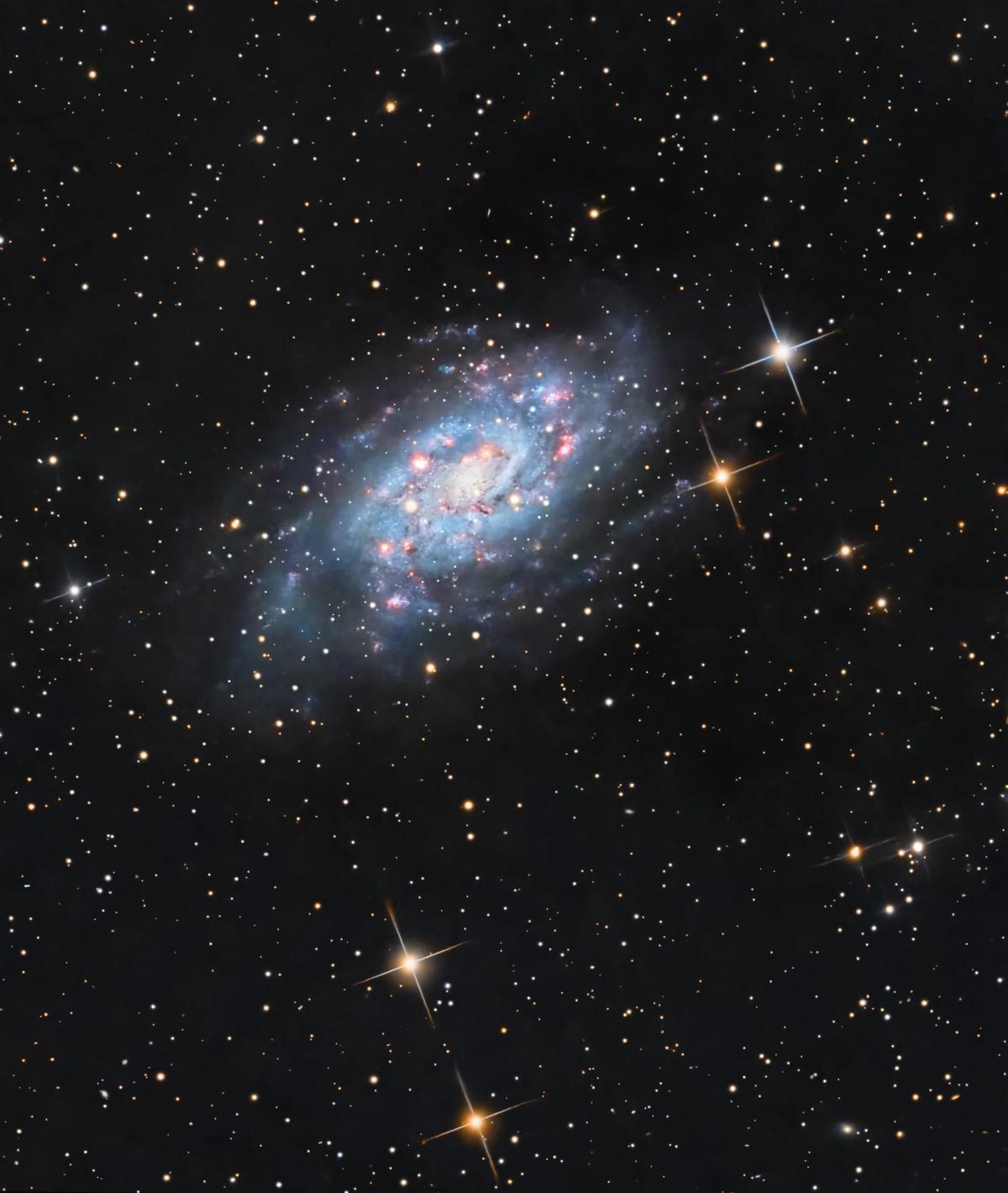
- •NGC 2403 resembles M33 in structure and star‑forming regions
- •Located 8 million light‑years away within the M81 galaxy group
- •Classified as Caldwell 7, a bright spiral in Camelopardalis
- •Imaged using 8‑inch f/4.8 telescope, 26.6‑hour exposure
- •Rich H II regions indicate ongoing vigorous star formation
Pulse Analysis
NGC 2403’s striking resemblance to the Triangulum Galaxy makes it a valuable comparative target for astronomers studying spiral dynamics. Both systems display loosely wound arms, modest central bulges, and extensive H II regions that trace active star formation. Situated 8 million light‑years from Earth, NGC 2403 lies on the periphery of the M81 group, offering a clear view of a galaxy that shares many physical parameters with M33 while existing in a distinct gravitational environment.
The abundance of bright H II complexes in NGC 2403 provides direct insight into the mechanisms that trigger and sustain star formation in low‑mass spirals. By analyzing the distribution and intensity of these regions, researchers can refine estimates of gas inflow rates, feedback processes, and the influence of nearby group members on galactic growth. Comparative studies between NGC 2403 and M33 help isolate variables such as metallicity gradients and dark‑matter halo profiles, advancing theoretical models of spiral galaxy evolution within the Local Volume.
Capturing NGC 2403 required a dedicated 26.6‑hour integration with an 8‑inch f/4.8 telescope and a one‑shot color camera, demonstrating the growing capability of advanced amateur equipment to contribute scientifically useful data. Such deep imaging not only enriches public outreach but also supplies high‑resolution photometric maps that professional surveys can leverage. Continued monitoring of NGC 2403 will track changes in its star‑forming knots, supporting long‑term studies of stellar population cycles and informing future missions targeting nearby spiral galaxies.
A Triangulum lookalike
0
Comments
Want to join the conversation?
Loading comments...