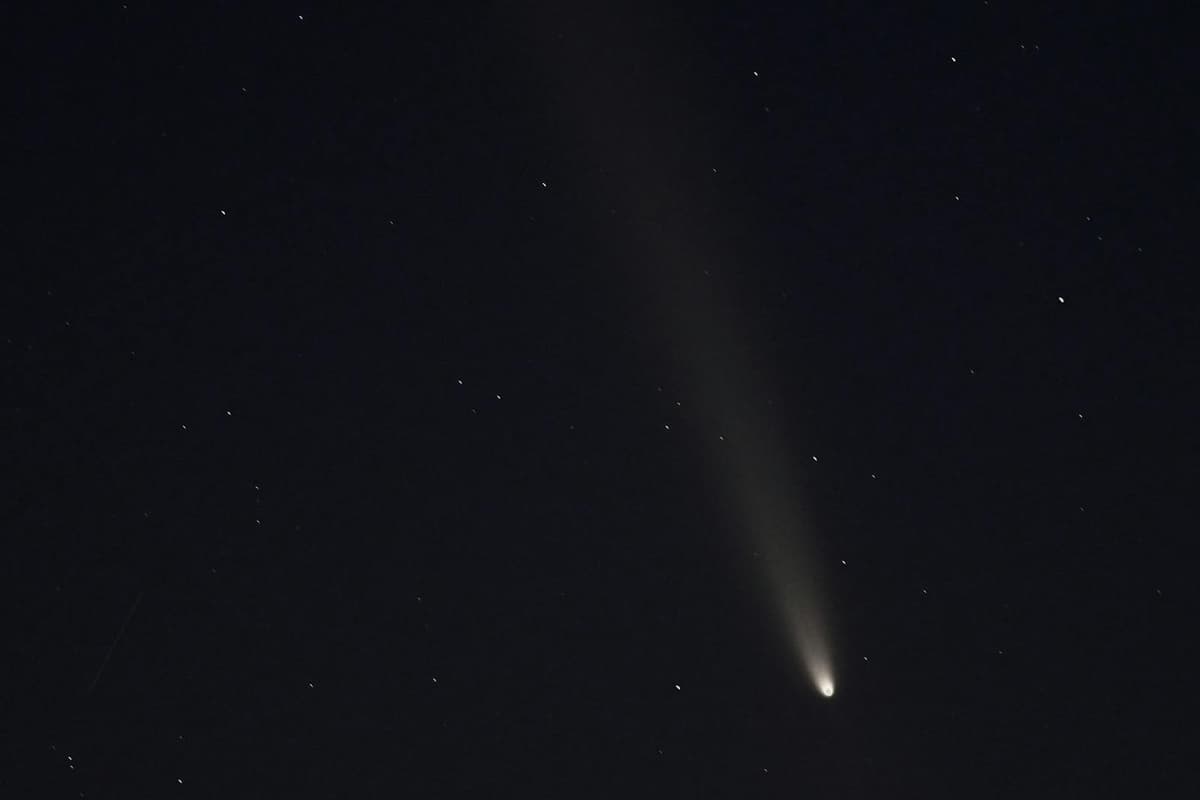
A Visitor From Deep Time: The 170,000-Year Comet Making Its Fleeting Farewell
Why It Matters
The comet provides a once‑in‑a‑lifetime chance for the public and astronomers to witness an object that last visited Earth before modern humans existed, highlighting the dynamic nature of our solar system. Its appearance also offers a rare data point on the behavior of pristine, long‑period comets as they approach the Sun.
Key Takeaways
- •Comet C/2025 R3 reaches magnitude +3 in mid‑April
- •Optimal viewing: pre‑dawn, low eastern horizon, dark skies
- •Northern Hemisphere window ends before perihelion, around late April
- •Southern observers see comet better from late April into May
- •Orbit period 170,000 years; last visit predates modern humans
Pulse Analysis
Long‑period comets like C/2025 R3 are cosmic time capsules, completing orbits that span geological epochs. Unlike short‑period comets that return every few years, this object last grazed the inner solar system when Homo sapiens were still sharing the planet with other hominins. Its arrival underscores the vastness of the Oort Cloud reservoir and reminds us that the solar system is a constantly evolving environment, where objects can reappear after timescales that dwarf human history. For astronomers, such comets are valuable laboratories for studying pristine ice compositions untouched by repeated solar heating.
For skywatchers, the challenge lies in timing and location. The comet will climb to magnitude +3 as it nears the Sun, but its brilliance will be masked by a brightening twilight, forcing observers to look just a few degrees above the eastern horizon before sunrise. The sweet spot falls in early to mid‑April for mid‑northern latitudes, where a clear, unobstructed horizon and minimal light pollution are essential. Binoculars (10×50) provide the best balance of magnification and light‑gathering, while a wide‑field telescope can reveal any emerging tail. Photographers should use a sturdy tripod, a 200‑400 mm lens, and ISO 1600‑6400 to capture the faint glow against the dawn sky.
Scientifically, C/2025 R3 offers insight into outgassing dynamics of a relatively untouched nucleus. As solar heat sublimates volatile ices, jets of gas and dust can alter the comet’s rotation and brightness unpredictably. Recent studies have shown that even modest jets can act as thrusters, reshaping a comet’s spin state. Monitoring this comet’s activity will help refine models of cometary evolution and improve predictions for future long‑period visitors. Though its next return lies 170,000 years ahead, the data gathered now will inform our understanding of the early solar system for generations to come.
A Visitor From Deep Time: The 170,000-Year Comet Making Its Fleeting Farewell
Comments
Want to join the conversation?
Loading comments...