Why It Matters
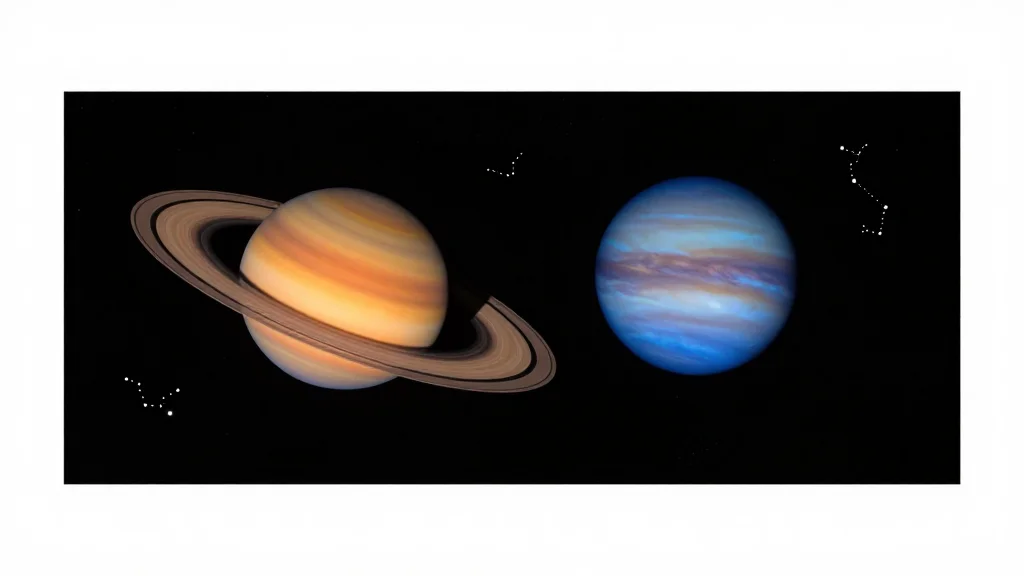
The synchronized retrograde motion provides a unique observational case for planetary dynamics, enriching both scientific study and public engagement with astronomy. It also showcases the capabilities of modern amateur and professional imaging techniques, underscoring market demand for advanced telescopic equipment.
Key Takeaways
- •Saturn and Neptune completed retrograde loops within a year
- •Their oppositions occurred on Sept. 21 and 23, 2025
- •Composite uses weekly exposures from May 2025 to Feb 2026
- •Loops observed in Pisces and Aquarius constellations
- •Visual highlights rare near‑synchronous planetary motion
Pulse Analysis
The 2025‑2026 retrograde dance of Saturn and Neptune offers a textbook example of how outer planets appear to move westward against the backdrop of fixed stars. As Earth overtakes these giants in its orbit, their apparent motion reverses, creating a loop that can span months. When two such loops align closely in time, as they did this year, the visual effect is amplified, making the planets appear to wander together across the zodiac. This phenomenon not only delights skywatchers but also provides valuable data for refining orbital models and testing gravitational theories.
Creating a seamless composite of this event required meticulous planning and consistent imaging cadence. Astronomers captured short exposures roughly once a week from May 9, 2025, through February 25, 2026, then aligned and stacked them to trace the planets’ paths. The process had to account for varying atmospheric conditions, light pollution, and the planets’ changing brightness. Advances in sensor sensitivity and image‑processing software now allow both professionals and serious amateurs to produce high‑resolution mosaics that were once the domain of large observatories, expanding the pool of contributors to celestial documentation.
Beyond scientific merit, the striking visual of a "wandering pair" fuels public fascination with space and drives demand for premium astrophotography gear. Telescope manufacturers see spikes in sales of equatorial mounts, high‑resolution cameras, and adaptive optics kits following such high‑profile events. Media outlets also leverage these images to attract readership, illustrating how a single astronomical occurrence can ripple through education, commerce, and technology sectors. As more observers contribute to real‑time sky monitoring, the industry stands to benefit from a growing market of engaged, tech‑savvy consumers.
A wandering pair
Comments
Want to join the conversation?
Loading comments...