Additive Research Update: Recyclable Resins, Musical Metasurfaces, Secret Spices, and More
Why It Matters
These advances push additive manufacturing toward clinical‑scale bioprinting, higher‑precision micro‑ceramics, and sustainable, low‑cost production, expanding its relevance across healthcare, electronics, and green manufacturing sectors.
Key Takeaways
- •EPFL volumetric printer prints millimeter objects in seconds, centimeter in minutes
- •Curcumin at 0.01% prevents blur, keeps 50 µm holes open
- •Penn State acoustic metasurface focuses sound to a one‑inch bubble
- •Anthracene‑based resin recycles ten times without photoinitiators
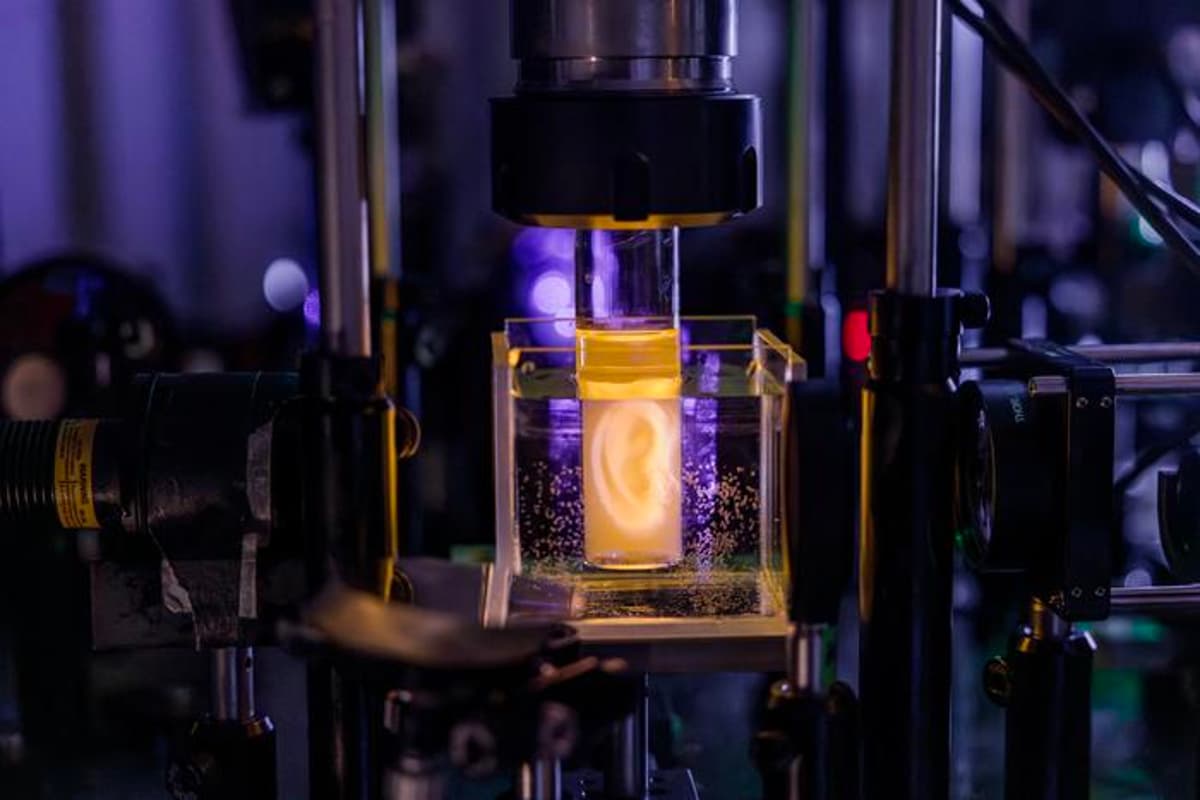
- •Low‑power 150 mW laser enables bioprinting of tissue‑scale ear
Pulse Analysis
The EPFL breakthrough in volumetric 3‑D printing redefines speed and scale for holographic manufacturing. By leveraging phase‑controlled holography, the system achieves 70‑fold efficiency gains, allowing entire objects to cure simultaneously. This capability not only accelerates prototyping but also opens pathways for bioprinting tissue‑scale implants, as demonstrated with a life‑sized human ear printed using a modest 150 mW laser. The technology’s compatibility with living cells positions it as a contender for near‑clinical regenerative medicine applications, where rapid, high‑resolution fabrication is critical.
In the realm of micro‑ceramic fabrication, Hunan University’s use of curcumin—a natural turmeric derivative—offers a low‑cost, environmentally benign solution to a persistent photopolymerization challenge. At just 0.01 % by weight, curcumin acts as a dual‑function agent, scattering stray light to preserve fine features while neutralizing free radicals that cause defects. The result is a dramatic reduction in blurring error to 26.1 µm and the ability to maintain 50‑µm channels that would otherwise clog. Because curcumin fully combusts during sintering, the final ceramic retains its intended density and strength, paving the way for scalable production of high‑precision components in electronics and biomedical devices.
Sustainability and acoustic control round out the latest additive manufacturing innovations. Yokohama National University’s anthracene‑based resin achieves true recyclability through reversible photodimerization, eliminating the need for photoinitiators and allowing at least ten reuse cycles without performance loss. Meanwhile, Penn State’s 3‑D‑printed acoustic metasurface transforms parametric array loudspeakers into highly directional audio emitters, focusing sound into a tight bubble and delivering low‑frequency output as low as 38 Hz. Both developments lower material waste and manufacturing costs, signaling a shift toward greener, more versatile additive processes that can be mass‑produced with conventional 3‑D printers.
Additive research update: recyclable resins, musical metasurfaces, secret spices, and more
Comments
Want to join the conversation?
Loading comments...