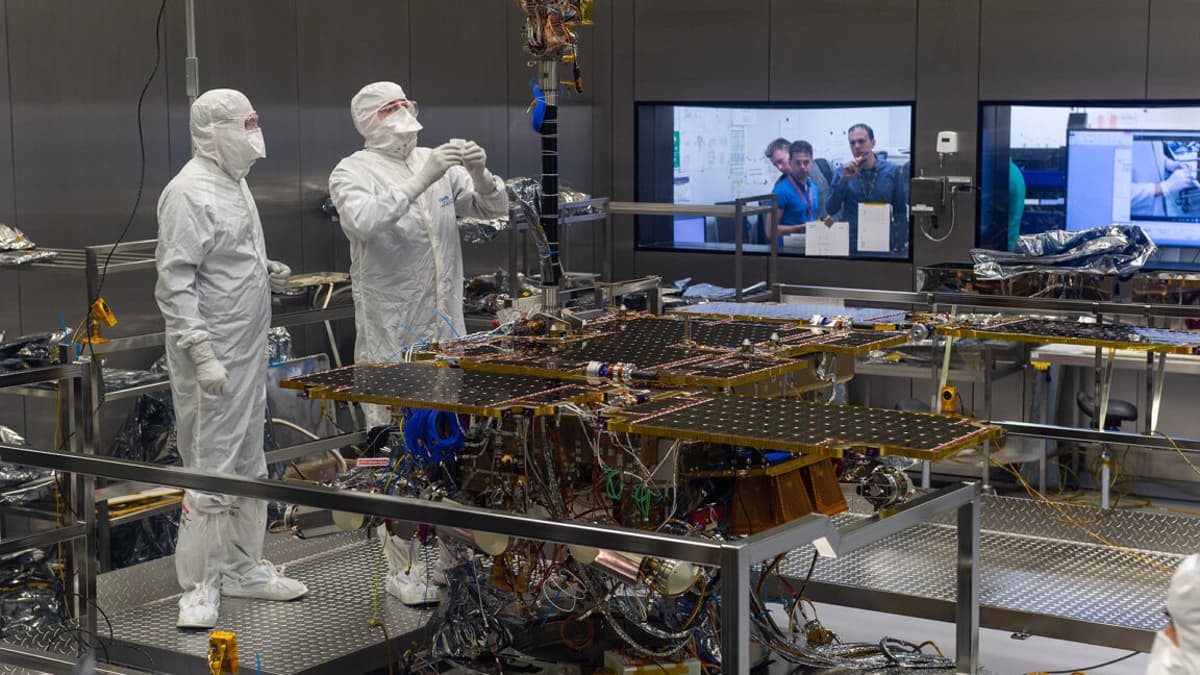
After a Saga of Broken Promises, a European Rover Finally Has a Ride to Mars
Why It Matters
The collaboration gives Europe a foothold on Mars while showcasing U.S. launch capabilities, reinforcing transatlantic space ties amid geopolitical tensions. Successful drilling could finally detect ancient biosignatures, advancing the search for life.
Key Takeaways
- •ESA's Rosalind Franklin rover to launch on SpaceX Falcon Heavy.
- •Launch slated for late 2028, targeting Mars arrival in 2030.
- •Mission will drill 2 m into Martian soil for organic analysis.
- •NASA provides launch vehicle, descent engines, and nuclear heaters.
- •Partnership shifts from Russia to US after Ukraine invasion.
Pulse Analysis
The Rosalind Franklin rover’s journey to Mars is the culmination of a 25‑year saga that began with ESA’s Aurora concept in the 1990s. Initial plans called for a Russian Soyuz launch, later shifting to a joint NASA‑ESA effort using Atlas V rockets before budget cuts forced NASA to withdraw. Russia’s subsequent involvement collapsed after the 2022 invasion of Ukraine, leaving ESA with a fully built rover but no launch path. By securing SpaceX’s Falcon Heavy, the United States not only rescued the mission but also reinforced its role as a reliable launch partner for international deep‑space projects.
Technically, Rosalind Franklin is a first‑of‑its‑kind platform. Its six‑wheel steering and “wheel‑walking” capability give it unprecedented mobility on rugged terrain, while a drill capable of reaching two metres below the surface aims to access organics shielded from radiation. Coupled with a mass spectrometer supplied by NASA, the rover will analyze subsurface samples for biomarkers that could survive billions of years. This depth exceeds that of any current rover, positioning the mission to fill a critical gap in Mars astrobiology and potentially provide the most compelling evidence yet of past life on the Red Planet.
From an industry perspective, the launch marks SpaceX’s debut Mars flight, signaling a new era where commercial heavy‑lift vehicles become the backbone of interplanetary exploration. The partnership also underscores a strategic realignment: Europe is now leaning on U.S. launch services while retaining autonomy over rover design and science. This model could accelerate future collaborations, reduce reliance on legacy state‑run launchers, and open commercial opportunities for payload integration, navigation, and surface operations. As Congress backs the FY‑2026 NASA budget, the mission illustrates how geopolitical shifts can reshape the economics and architecture of planetary science.
After a saga of broken promises, a European rover finally has a ride to Mars
Comments
Want to join the conversation?
Loading comments...