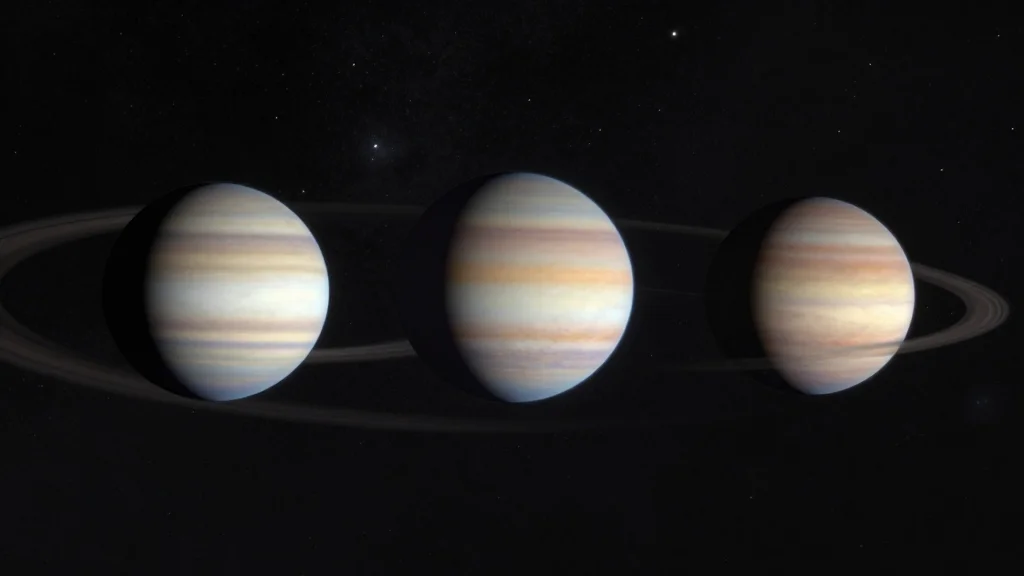
Alien Life May Hide in Plain Sight: Statistical Patterns Across Exoplanets Move Beyond Traditional Biosignatures
Why It Matters
By shifting focus from single‑planet biomarkers to planetary ensembles, the technique offers a more reliable way to prioritize targets for costly observations, potentially accelerating the discovery of life beyond Earth.
Key Takeaways
- •Life’s spread creates detectable statistical correlations among nearby exoplanets.
- •Method clusters planets by traits and proximity to flag likely biosignature hosts.
- •Approach reduces false positives, prioritizing reliability over completeness.
- •Simulations show patterns emerge without identifying individual biosignature gases.
- •Future surveys can use population analysis to guide limited telescope time.
Pulse Analysis
Traditional biosignatures—oxygen, methane, or other atmospheric gases—have long been the cornerstone of astrobiology, yet they are prone to false positives from abiotic chemistry. Researchers at the Earth‑Life Science Institute and the National Institute for Basic Biology recognized that relying on a single chemical marker limits the reliability of life detection, especially as upcoming telescopes will probe dozens of faint exoplanet atmospheres. Their new framework sidesteps these constraints by treating life as a planetary engineer that can migrate and reshape environments, leaving behind large‑scale statistical footprints that are harder to mimic by non‑biological processes.
The core of the study is an agent‑based model that simulates panspermia—microbial transfer between worlds—and subsequent terraforming. When life spreads, planets within a certain radius become more similar in observable traits such as atmospheric composition or surface reflectivity. By applying clustering algorithms to simulated data, the team identified groups where trait similarity exceeds random expectations, effectively flagging regions of the galaxy where life’s collective influence is most likely. Crucially, the method does not require prior knowledge of alien biochemistry; it only needs enough planetary observations to establish a baseline of natural diversity, then looks for statistically significant deviations.
For the next generation of exoplanet missions—James Webb Space Telescope, the Nancy Grace Roman Space Telescope, and ground‑based Extremely Large Telescopes—this population‑level approach could become a decision‑making tool. Instead of allocating precious observation time to every candidate, astronomers can prioritize clusters that exhibit the predicted correlations, maximizing the chance of a genuine detection while conserving resources. The authors stress that real‑world application will demand refined models of planetary formation and galactic dynamics, as well as comprehensive catalogs of planet properties. As the exoplanet census expands, statistical biosignatures may prove essential for turning the search for life from a speculative endeavor into a data‑driven science.
Alien life may hide in plain sight: Statistical patterns across exoplanets move beyond traditional biosignatures
Comments
Want to join the conversation?
Loading comments...