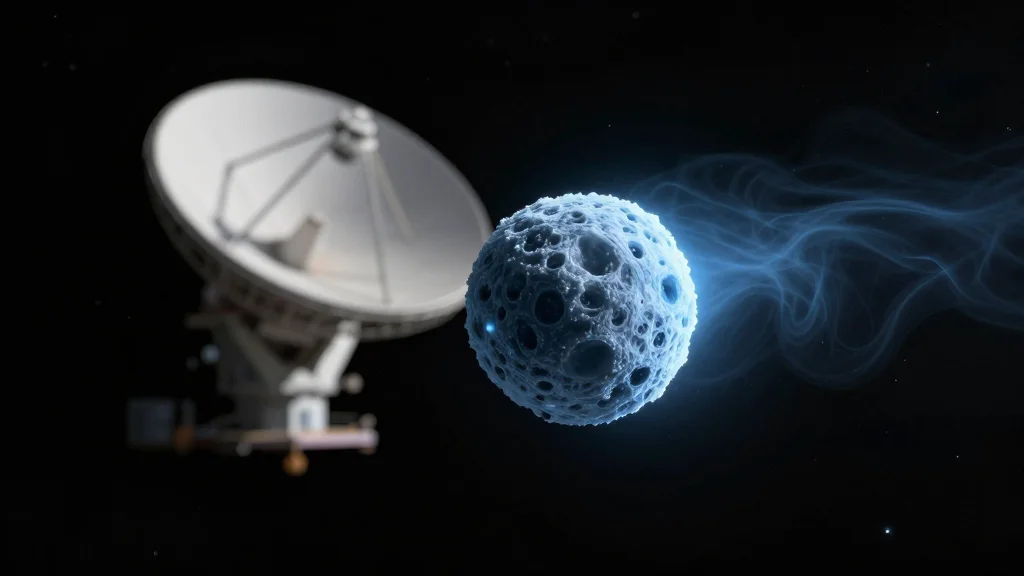
ALMA Finds Interstellar Comet 3I/ATLAS Originated in Ultra‑Cold Milky Way Region

Companies Mentioned
Why It Matters
The measurement of an extreme deuterium enrichment in 3I/ATLAS provides a direct probe of the temperature and radiation conditions in a distant star‑forming region, offering a rare empirical anchor for theories of planetary system formation beyond the Solar System. By establishing that at least some planetary systems arise in far colder, more isolated environments, the study expands the known parameter space for planet‑forming disks and may influence how astronomers interpret the chemical makeup of exoplanet atmospheres. Beyond pure science, the result underscores the strategic value of ground‑based radio observatories like ALMA for time‑critical observations of fast‑moving interstellar objects. As the frequency of detected interstellar visitors is expected to rise with next‑generation surveys, the ability to capture their fleeting chemical signatures will become a cornerstone of planetary science, potentially informing the search for biosignatures and the broader quest to understand the distribution of habitable worlds in the Milky Way.
Key Takeaways
- •ALMA measured a deuterated‑water (HDO) ratio at least 30× higher than in Solar System comets.
- •The D/H enrichment implies formation in temperatures below 30 K, far colder than the early Solar nebula.
- •Study led by Luis E. Salazar Manzano and Teresa Paneque‑Carreño, published in Nature Astronomy (April 24, 2026).
- •Comet 3I/ATLAS may be up to 11 billion years old, making it the oldest known interstellar object.
- •Findings push astrochemical models to include ultra‑cold, isolated galactic environments.
Pulse Analysis
ALMA’s breakthrough illustrates a paradigm shift in how the astronomical community will treat interstellar interlopers. Historically, the rarity of such objects limited their scientific return to orbital dynamics and bulk composition. The 3I/ATLAS deuterium result flips that script, turning a fleeting visitor into a time capsule that records the thermochemical conditions of a distant star‑forming cloud. This elevates the strategic importance of rapid‑response sub‑millimeter facilities, which can observe comets even when they are sunward of most optical telescopes.
From a historical perspective, the first interstellar object, ‘Oumuamua, offered only a silhouette of its shape and a puzzling non‑gravitational acceleration, leaving its composition largely speculative. By contrast, 3I/ATLAS provides a quantitative chemical metric that can be directly compared to Solar System benchmarks. The 30‑fold HDO enrichment forces a reevaluation of the assumed universality of the Solar nebula’s temperature gradient, suggesting that a substantial fraction of planetary systems may emerge from much colder, less irradiated niches. This could explain the growing diversity observed in exoplanet atmospheres, where some worlds display unexpected metallicities and molecular ratios.
Looking ahead, the field is likely to see a surge in coordinated campaigns that combine ALMA’s Sun‑pointing capability with space‑based infrared spectrographs, aiming to capture a broader suite of isotopic markers (e.g., ^15N/^14N, ^13C/^12C). Such multi‑modal datasets will refine models of ice chemistry, grain surface reactions, and the inheritance of primordial isotopic signatures. In the longer term, the ability to map the chemical fingerprints of interstellar objects may become a diagnostic tool for tracing galactic stellar migration patterns, effectively turning cometary chemistry into a galactic archaeology method.
ALMA Finds Interstellar Comet 3I/ATLAS Originated in Ultra‑Cold Milky Way Region
Comments
Want to join the conversation?
Loading comments...